Choose slab doors for an uninterrupted modern kitchen, or slim Shaker doors when you want a framed detail without a heavily traditional profile. For a Los Angeles kitchen remodel in 2026, decide the door style alongside the finish, opening method, and cabinet layout—not from a photograph alone. This guide helps homeowners commissioning complete custom cabinetry turn those choices into a clear design brief.
- For kitchen cabinets los angeles modern searches, slab doors suit clean lines; slim Shaker adds restrained detail.
- Polaris Home Design offers custom kitchen cabinetry for homeowners remodeling in the North Hollywood area.
- Compare door profiles, finish samples, and opening methods together before approving a complete cabinetry design.
- Request a full-size door sample; small finish chips cannot show the complete profile.
How do you choose modern kitchen cabinet doors in Los Angeles?
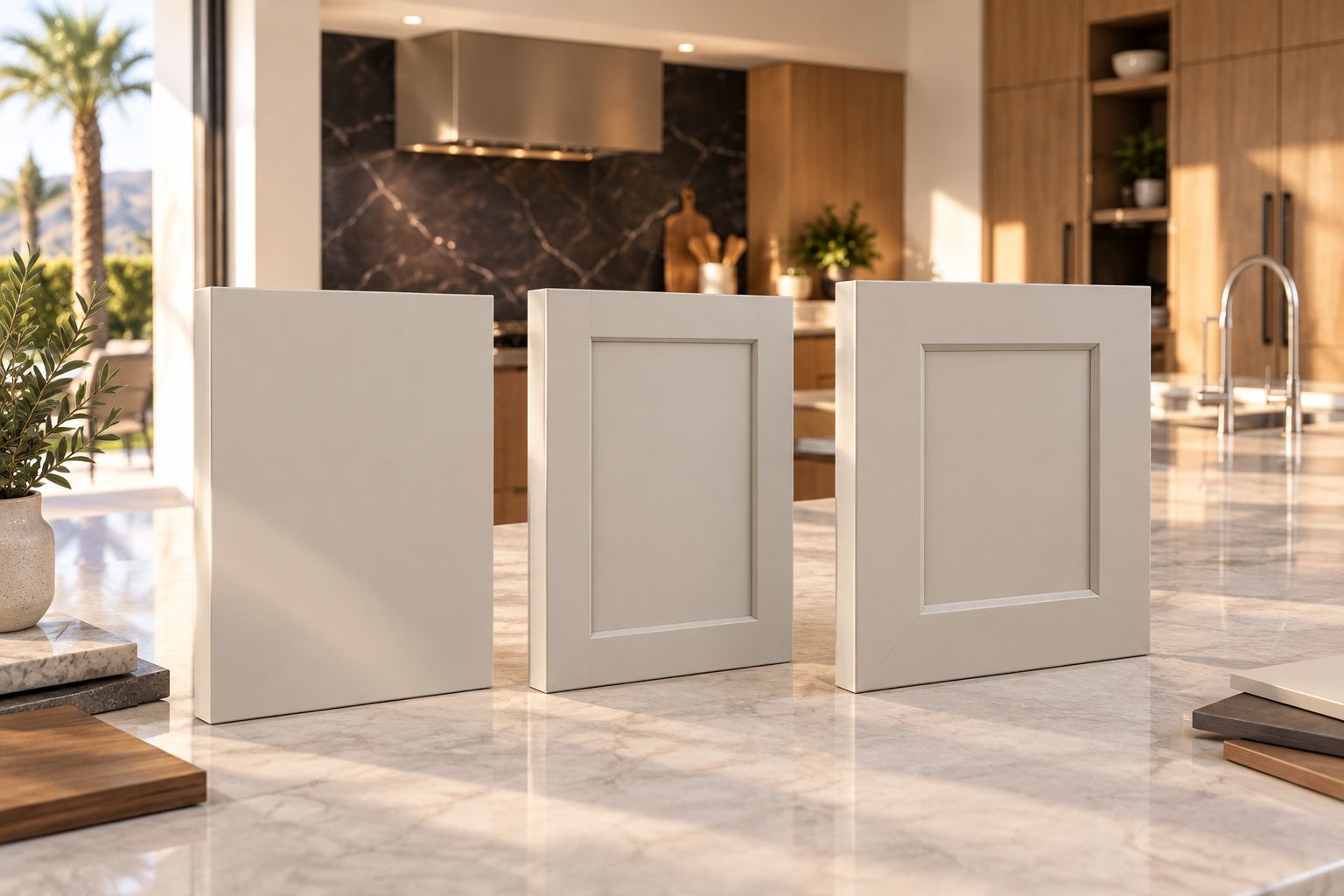
Start with the amount of visible detail you want, then test that preference against the kitchen's layout and everyday use. These 3 door styles offer distinct starting points: slab removes the frame, slim Shaker keeps a narrow frame, and conventional Shaker makes the frame more prominent. None substitutes for thoughtful cabinet planning.
| Door style | Best for | Main advantage | Main limitation | What to inspect |
|---|---|---|---|---|
| Slab | Homeowners wanting uninterrupted surfaces | Keeps attention on proportion, material, and finish | Uneven gaps or inconsistent alignment interrupt the simple appearance | Door edges, meeting lines, and finish consistency |
| Slim Shaker | Homeowners wanting modern lines with restrained detail | Adds a framed profile without a broad border | The profile introduces more edges to clean than a flat door | Frame width, recessed corners, and drawer-front treatment |
| Conventional Shaker | Homeowners wanting a modern kitchen with a more familiar framed character | Gives the cabinetry a clearly defined face | A prominent frame adds visual activity, especially across many small fronts | Rail proportions, hardware placement, and repeated frame lines |
Slab is the clearest starting point for a minimalist brief; slim Shaker is the better starting point when you want visible craftsmanship expressed through a framed profile. Conventional Shaker remains a valid choice, but judge the whole elevation rather than assuming any framed door will read as modern.
Door style and cabinet construction are separate decisions. A slab door does not automatically mean frameless cabinetry, and a Shaker door does not require inset installation. Ask the designer to show the door profile and how the doors sit on the cabinet boxes as separate parts of the specification.
Why this matters
A kitchen door repeats across the entire room. A detail that looks restrained on a sample can become dominant when it appears on every cabinet, drawer, and tall pantry front. That repetition makes door selection a layout decision as much as a finish decision.
For homeowners planning a complete custom kitchen, Polaris Home Design offers bespoke cabinetry in the North Hollywood area. The studio's design, build, and installation approach suits a project that needs these decisions coordinated rather than treated as separate purchases. The limitation is straightforward: a door photograph cannot establish the final proportions, material specification, or installation details of your kitchen.
For your 2026 project, bring the room plan and your storage needs into the first design discussion. A preferred cabinet image is useful, but it does not explain where you need drawers, which appliances require coordination, or how the kitchen connects to adjoining rooms.
Slab doors: best for uninterrupted modern surfaces
Slab doors have a flat face without a surrounding frame. Their simplicity directs attention toward the finish, the proportions of each front, and the pattern created by the gaps between them. In a modern kitchen, those quiet elements carry much of the design.
Choose slab when you want a long cabinet run to read as a coordinated surface rather than a collection of framed panels. The approach works with painted faces, wood veneer, and other specified finishes; the material changes the character even when the door shape stays the same. A wood surface introduces grain, while a painted surface emphasizes color and reflected light.
The trade-off is visibility. Simple faces do not disguise irregular alignment, inconsistent edge treatment, or a poorly resolved transition beside an appliance. Review how the design handles end panels, exposed sides, and the meeting point between tall cabinets and lower cabinets.
- Best for: A kitchen brief centered on clean lines and controlled visual detail.
- Advantage: The door profile does not compete with the countertop, backsplash, or wood grain.
- Limitation: The finished result depends on resolving the cabinet elevation, not merely choosing a flat door.
- Recommendation: Approve slab doors only after reviewing the complete cabinet elevations and a representative sample.
Slim Shaker doors: best for restrained framed detail
Slim Shaker doors use a narrower surrounding frame than a conventional Shaker profile. The result is a visible border with less emphasis on the frame itself. Choose this direction when a completely flat door feels too plain, but a broad frame feels too pronounced.
The name alone is not a specification. Different door makers use different proportions and edge details, so request the actual profile rather than approving a category label. Look at the junction between the frame and center panel, then consider how that detail repeats across wide drawers and narrow doors.
A slim frame can support a modern design, but it still creates recessed corners and additional edges. Those features need attention during cleaning. They also change how light falls across the cabinetry, making a physical sample more useful than a front-facing photograph.
- Best for: Homeowners who want framed cabinetry without a strongly traditional appearance.
- Advantage: The profile provides definition while retaining a restrained face.
- Limitation: Narrow drawers and small doors need careful treatment so the frame does not dominate.
- Recommendation: Ask for the proposed door and drawer-front profiles together before approving either.
Conventional Shaker doors: best for a modern transitional kitchen
Conventional Shaker doors have a more prominent frame around the center panel. They suit a brief that combines modern planning with a familiar cabinet face. The distinction matters: a modern kitchen does not have to eliminate every traditional reference.
The broader frame creates more repeated lines. Across a wall of small cabinets, those lines become a larger part of the room's appearance. Use the elevation drawings to judge whether the balance of doors, drawers, and tall fronts gives you the degree of detail you actually want.
Hardware and surrounding materials should support that decision. A simple handle does not erase a substantial frame, just as a restrained countertop does not change the door's geometry. Select the profile because you want its character, not because you expect another finish to cancel it out.
- Best for: Homeowners seeking a modern transitional kitchen rather than strict minimalism.
- Advantage: The framed face gives each cabinet a defined architectural character.
- Limitation: Repeated borders create more visual activity than slab fronts.
- Recommendation: Compare a full cabinet elevation with a slab or slim Shaker alternative before committing.
Why the right door style varies by kitchen
The strongest choice depends on how the door interacts with the room, not whether a style appears in a current inspiration image. Use these factors to narrow your brief:
- Room architecture: Decide whether the cabinetry should echo existing trim and architectural detail or provide a quieter contrast.
- Cabinet proportions: Review narrow doors, wide drawers, and tall fronts together. A profile does not look identical at every size.
- Finish and grain: Consider whether you want continuous color, visible wood character, or a deliberate combination. Ask how grain direction will be specified.
- Opening method: Handles, integrated pulls, and push-to-open mechanisms affect the experience of using the door and the appearance of its edge.
- Cleaning preferences: A flat face and a recessed frame present different surfaces to maintain. Inspect corners and pull recesses before choosing.
- Adjacent materials: Coordinate the door sample with the countertop, backsplash, flooring, and visible appliance finishes.
For a North Hollywood remodel, use your own home's conditions as the reference. A kitchen photographed in Beverly Hills or elsewhere in Los Angeles can provide inspiration, but its cabinet proportions and lighting do not establish what belongs in your room.
A 2026 inspiration board should communicate preferences, not become an instruction to copy another kitchen. Identify what you like in each image: the flat face, the wood grain, the framed edge, or the handle placement. Those observations give your designer something specific to work with.
How do you turn a preferred door style into a cabinetry brief?
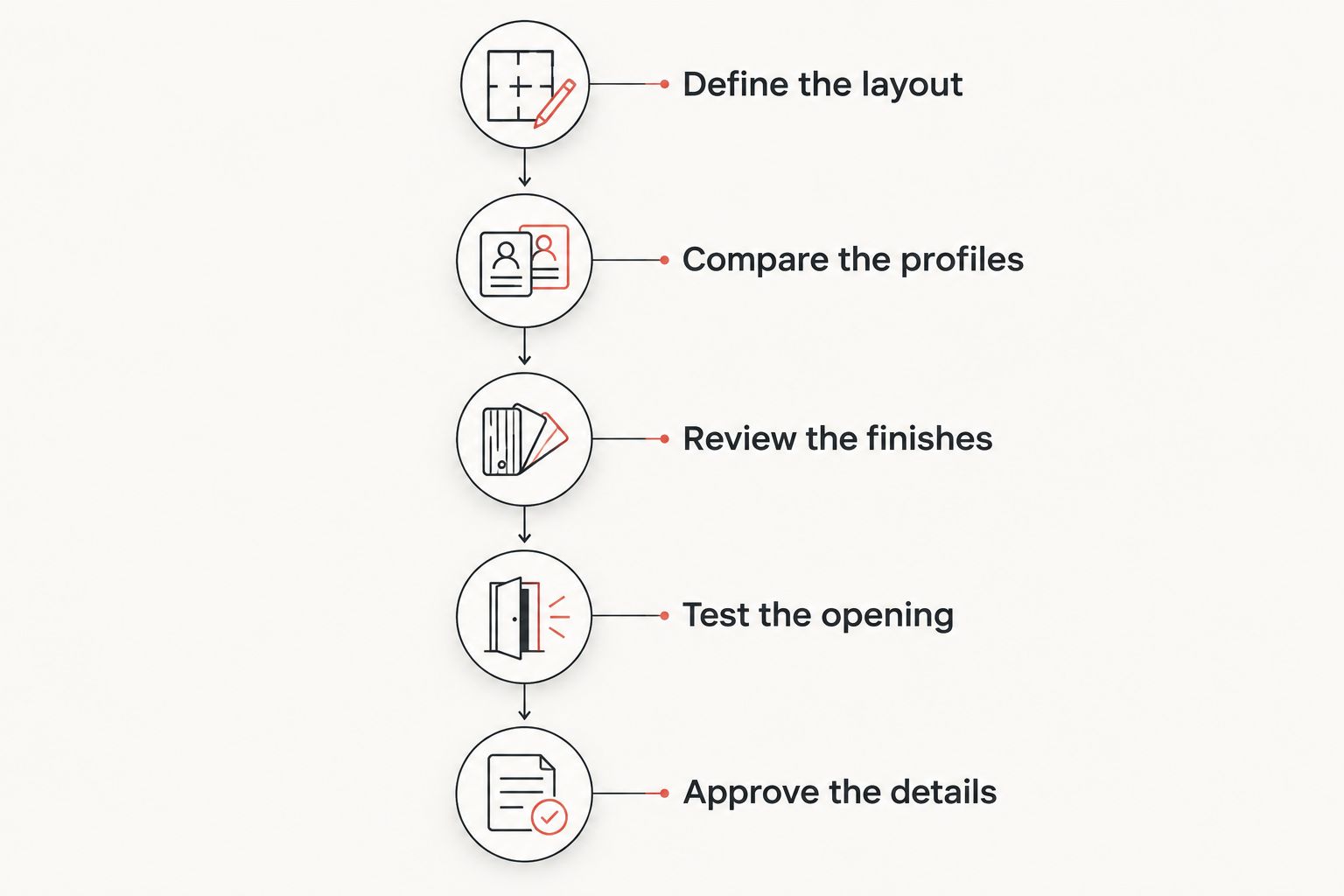
Follow this sequence before authorizing the final cabinetry specification. It moves from the room's needs to the details you will see and touch every day.
- Define the layout. Describe how you cook, what you store, and which existing arrangements do not work. Establish the relationship between appliances, work surfaces, and storage before fine-tuning the door appearance.
- Compare the profiles. Review slab, slim Shaker, or conventional Shaker within the proposed cabinet elevations. Keep the finish consistent during this comparison so the profile remains the decision.
- Review the finishes. Compare 2 finish samples in the kitchen's daylight and evening lighting. Place them beside the other proposed materials rather than viewing them in isolation.
- Test the opening. Handle a representative door or drawer with the proposed opening method. Check the grip, edge feel, and the reach required for the intended location.
- Approve the details. Review 1 full-size door sample alongside the drawings. Confirm the profile, finish, exposed ends, hardware placement, and how different cabinet runs meet.
The counts above are a practical review plan, not a material standard. The purpose is to move beyond a small color chip and a photograph. Your final specification should describe the actual cabinetry being commissioned.
Your 2026 cabinetry brief should keep the design drawings and physical samples connected. If the finish changes, revisit the opening detail; if the profile changes, revisit the drawer fronts. Approval works best when these elements describe the same final design.
Polaris Home Design is best suited to North Hollywood homeowners commissioning a complete custom cabinetry project rather than shopping for replacement doors alone. Discuss the kitchen as a whole, including the storage layout and installation details, instead of treating the door style as a standalone purchase.
Discuss your complete cabinetry project
Bring your layout, storage priorities, and preferred door profiles into a custom kitchen discussion.
Are slab doors more modern than Shaker doors?
Slab doors express a more minimal appearance because they omit the surrounding frame. Shaker doors can still belong in a modern kitchen when the profile, proportions, and surrounding materials support that direction. Choose based on the complete elevation, not the style name alone.
Should modern kitchen cabinets have handles?
Modern kitchen cabinets can have handles; visible hardware does not make a kitchen traditional. Handles provide a defined place to grip, while integrated pulls and push-to-open mechanisms change how you operate the front. Test the proposed method rather than choosing it solely for its appearance.
Should every cabinet use the same door profile?
A consistent profile gives the cabinetry a clear design language, but drawer fronts still require deliberate specification. Ask whether shallow drawers, wide drawers, and tall doors use the same treatment or a planned variation. An intentional difference is easier to approve when it appears clearly in the elevations.
FAQ
What’s the best door style for a modern kitchen in Los Angeles?
Slab doors are the clearest starting point for an uninterrupted modern appearance. Slim Shaker is a strong alternative when you want a restrained framed detail; compare both within your actual cabinet elevations.
Are slim Shaker cabinets the same as standard Shaker cabinets?
Slim Shaker cabinets use a narrower surrounding frame than conventional Shaker cabinets. The name does not define an exact profile, so review the maker’s actual sample before approving it.
Do slab cabinet doors always mean frameless cabinets?
Slab cabinet doors do not automatically mean frameless cabinet construction. Specify the door profile and cabinet construction separately so the drawings reflect both decisions.
How do I choose between painted and wood cabinet doors?
Choose painted doors when your brief centers on color, and wood-faced doors when visible grain is part of the design. Review physical samples beside your countertop, backsplash, and flooring before deciding.
Can I choose modern cabinets without a handleless design?
Modern cabinets can use visible handles. Judge the hardware’s placement and appearance alongside the door profile, and test how comfortably you can operate the proposed front.
What should I bring to a custom kitchen cabinetry consultation?
Bring your room plan, appliance information, storage priorities, and reference images that show specific details you like. Polaris Home Design’s custom kitchen cabinetry offering is relevant to homeowners planning a complete North Hollywood remodel.
One last thing
Compare the door edge, not just the door face. The edge is where your hand meets the cabinet and where the finish, profile, and opening method come together. A beautiful front-facing image leaves that decision unresolved.
Before approving your 2026 kitchen design, handle the representative sample and inspect it from the side. Then look back at the elevation. The right door should make sense both as an object in your hand and as a repeated element across the room.