Handleless kitchen cabinets are right for a Los Angeles home when you want uninterrupted cabinet fronts and are willing to plan how every door, drawer, and appliance opens. The trade-off is that removing visible pulls does not remove hardware decisions: grip clearance, opening force, finish maintenance, and installation alignment still matter. For a complete kitchen remodel in 2026, choose the opening method before approving the cabinet elevations.
- For kitchen cabinets los angeles handleless searches, compare recessed grips, integrated pulls, and push-to-open mechanisms before choosing fronts.
- Polaris Home Design suits North Hollywood homeowners commissioning complete custom kitchen cabinetry, not a hardware-only update.
- Handleless kitchen cabinets need coordinated grip clearances, appliance openings, and door alignment.
- Test a working sample; an uninterrupted cabinet elevation does not prove comfortable daily use.
Why this matters
A handleless kitchen makes the opening mechanism part of the cabinetry design, rather than an accessory selected afterward. That changes how you review drawings: the spaces between fronts, countertop edges, and appliance doors deserve as much attention as the finish.
For homeowners planning a full kitchen renovation in North Hollywood or nearby Los Angeles neighborhoods, modern kitchen cabinet door styles provide the visual starting point. Handleless operation is a separate specification. A flat door can have a pull, and an apparently handleless door can conceal a mechanical opening system.
Decide how the kitchen should feel in your hands before deciding how it should look in a rendering. That is the central planning decision for a handleless project in 2026.
Are handleless kitchen cabinets right for a Los Angeles home?
Yes, if you prefer an uninterrupted appearance and the chosen opening method works for everyone using the kitchen. No, if you want a projecting grip on every front or do not want to coordinate touch points and clearances throughout the cabinet layout.
Compare these 3 opening methods before selecting a direction. Each removes a conventional projecting handle, but each asks something different of your hand and the cabinet construction.
| Opening method | Best for | Main advantage | Main limitation |
|---|---|---|---|
| Recessed grip channel | Homeowners wanting a continuous grip line | Your fingers reach behind the front without a projecting pull | The channel needs space and coordination across cabinet runs |
| Integrated edge pull | Homeowners wanting the grip incorporated into each front | The opening point stays with the door or drawer | Comfort depends on the edge profile and usable finger space |
| Push-to-open | Homeowners wanting fronts without a visible grip | You press the front to release the opening mechanism | Operation depends on the specified mechanism, adjustment, and user technique |
These are design options, not interchangeable labels. Ask the cabinet studio to identify the proposed method on each part of the kitchen, including upper cabinets, tall storage, and integrated appliance fronts.
Recessed grip channels: best for a continuous grip line
A recessed channel creates a place for your fingers behind the door or drawer edge. It lets you pull the front open while keeping a grip line within the cabinet elevation.
The benefit is a defined place to reach. The constraint is that the channel must fit the cabinetry layout, with deliberate decisions at corners, end panels, and changes in cabinet height. Do not approve a long uninterrupted line in a drawing without reviewing where it stops.
Ask to see the channel in section, not only from the front. A section drawing shows the relationship between the cabinet front, grip space, and countertop edge; a front elevation cannot explain that relationship by itself.
Choose a recessed channel when you like the visible line it creates and find the actual grip comfortable. Treat the channel as part of the composition, rather than something to hide at all costs.
Integrated edge pulls: best for a grip built into the front
An integrated edge pull places the gripping detail in or along the cabinet front itself. The exact construction needs to be specified; the phrase alone does not tell you the material, shape, or depth of the grip.
This approach keeps the opening point associated with each door or drawer. Its limitation is equally direct: a profile that looks restrained from across the room can feel awkward at close range.
Request a working sample that includes the proposed finish and edge treatment. Open it with your usual hand position, then test an upper door and a lower drawer rather than assuming the same detail feels identical everywhere.
For a 2026 kitchen specification, record the selected profile alongside the front material. Approving a finish sample without approving the gripping edge leaves an important daily-use decision unresolved.
Push-to-open: best for fronts without a visible grip
Push-to-open cabinetry uses a mechanism that releases when you press the front. It avoids a finger channel or projecting pull, making it an option when you want the cabinet faces to read as uninterrupted planes.
The limitation is operational: the release mechanism, hinges or runners, front dimensions, and adjustment must work together. Do not assume that a soft-close component and a push-to-open component are compatible without confirmation for the specified system.
Ask where to press, how the front moves after release, and how you complete the opening. Test the full action instead of stopping when the latch disengages. A drawer that releases successfully still needs to feel comfortable as you pull it out and close it.
Choose push-to-open only after trying the proposed operation on a working assembly. A photograph cannot establish opening force, release behavior, or closing feel.
Why handleless cabinet suitability varies
The deciding factors are practical, not simply whether the home has a modern architectural style. Review these points against your own household and layout:
- Grip comfort: Test the proposed profile with the people who will regularly use the kitchen. A small edge detail is not automatically easier to hold.
- Front material and finish: Compare samples for appearance, touch, and the maker's cleaning instructions. Handleless operation puts your hand directly on or behind the front.
- Cabinet position: Upper doors, deep drawers, and tall doors create different reaching and pulling actions. Evaluate each application.
- Appliance coordination: Confirm the appliance manufacturer's opening, ventilation, and installation requirements before treating an appliance front like a storage door.
- Room geometry: Corners, adjacent fronts, walls, and countertop projections affect access. Check movement in the layout, not just spacing in the elevation.
- Installation and adjustment: Agree who checks alignment and operation at completion, including the relationship between channels, fronts, hinges, and runners.
For your 2026 brief, describe these as requirements to resolve, not assumptions that come with the word custom.
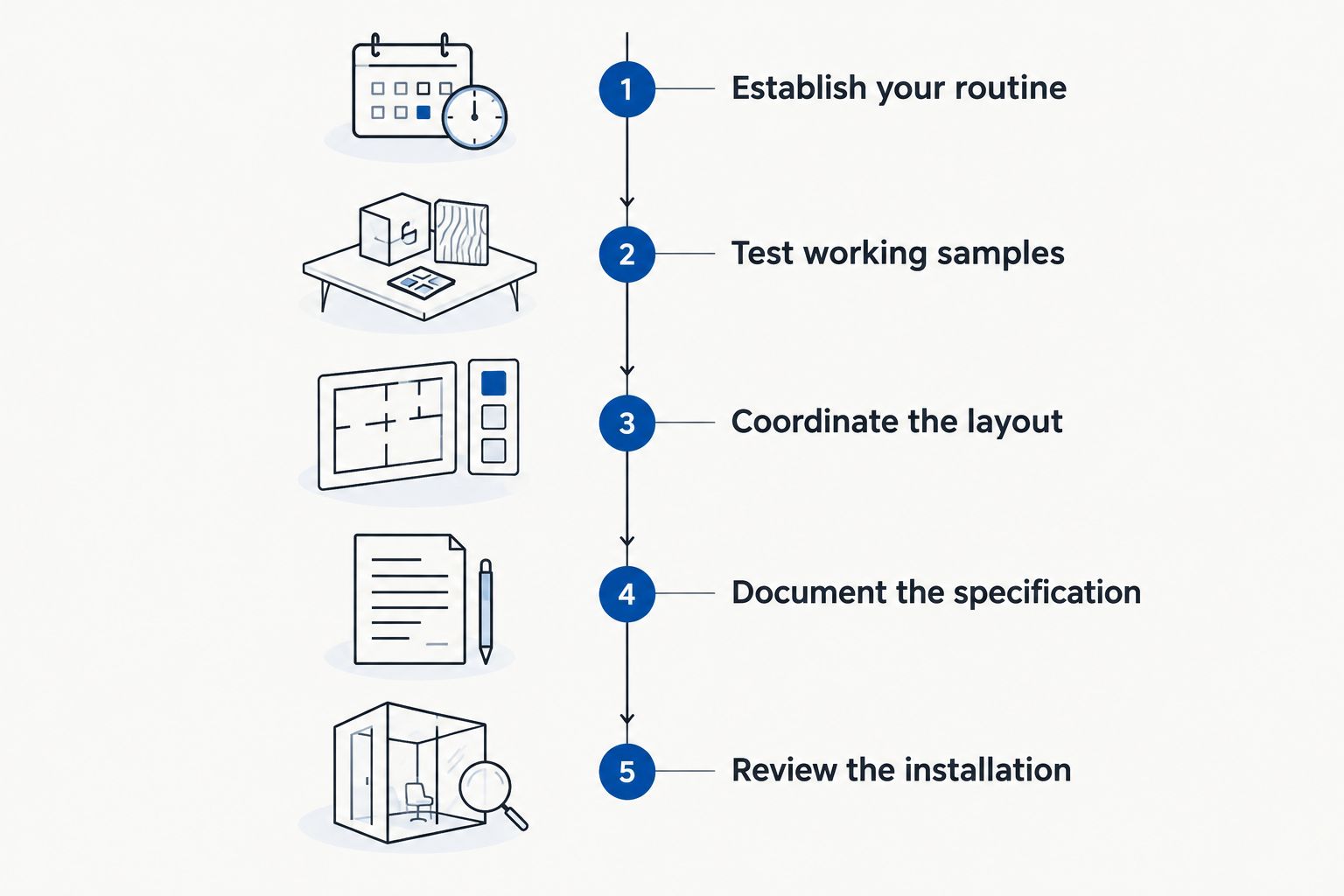
How should you plan a complete handleless kitchen?
Start with the way you use the room, then work toward the appearance. The following sequence keeps opening details connected to the complete cabinetry project.
Establish your routine
List the storage you reach for during preparation, cooking, and clearing away. Identify heavy cookware, frequently used drawers, and tall storage. This gives the designer specific actions to accommodate instead of a general request for a minimalist kitchen.
Also identify anyone who needs a more substantial grip or a different opening action. You do not need to prescribe the solution yourself; you need to make that requirement explicit before the cabinet design is settled.
Test working samples
Request 1 full-size working sample of the preferred opening detail rather than relying only on a small finish chip. Examine the edge from standing height and use it as you would at home.
A finish chip helps you judge color and surface. A working assembly helps you judge reach, grip, release, and closing. Both matter, but they answer different questions.
Coordinate the layout
Review cabinet sections alongside elevations and the appliance schedule. Check how 2 adjacent doors move, where a drawer passes another front, and how a tall door behaves beside a wall.
This is also the point to resolve countertop overhangs and end conditions. Do not leave those details to separate selections that never appear together on a coordinated drawing.
Document the specification
Record the opening method, front construction, finish, hardware, and relevant clearances in the approved package. If different cabinet areas use different mechanisms, identify them individually.
Ask who carries those decisions through design, fabrication, and installation. The guide to what in-house custom cabinetry means helps frame that discussion around responsibility rather than terminology.
Review the installation
Open and close the cabinetry during the completion review. Check that the agreed grip details, door movement, and alignment match the approved design, and record any adjustments needed.
Review appearance with the fronts closed, then review function with them moving. Neither check replaces the other.
Can you combine handleless cabinets with visible pulls?
Yes. A mixed approach lets you select an opening method by application rather than forcing the same detail onto every cabinet.
The advantage is flexibility; the limitation is that every change in hardware becomes part of the visual design. Show those transitions on the elevations so they look intentional. For a 2026 remodel, ask the designer to explain why each exception improves use, rather than adding exceptions after fabrication.
Will handleless cabinets be harder to keep clean?
Handleless cabinets still need cleaning at the points you touch. Recessed channels also create a surface to include in your cleaning routine, while push-to-open fronts require direct contact with the face.
The finish and cleaning instructions determine the appropriate care. Compare physical samples and ask for written guidance rather than accepting a blanket claim that all handleless kitchens are easier—or harder—to maintain.
Can you use handleless fronts on integrated appliances?
Handleless appliance fronts require an appliance-specific plan. A cabinetry opening mechanism does not establish compatibility with a refrigerator or dishwasher.
Confirm the exact appliance requirements before approving the surrounding cabinets. Ask the designer to show how you will open the appliance, where your fingers go, and how the front moves without interfering with adjacent cabinetry.
Who should commission this kind of cabinetry?
Polaris Home Design is best for North Hollywood homeowners commissioning complete custom cabinetry. Its stated offering includes custom kitchen cabinets, bathroom vanities, closets, and quartz countertops, making the relevant conversation a complete project rather than a replacement-hardware purchase.
For a handleless kitchen, bring room information, appliance selections, and examples of the opening details you prefer. Ask Polaris Home Design to address the cabinetry design, construction, and installation together, including how the chosen mechanism will be demonstrated and documented.
The advantage of a custom project is the opportunity to resolve these details as one design. The obligation for you is to make decisions beyond the cabinet color: grip comfort, appliance operation, and finish care all need approval.
Discuss Your Complete Kitchen Project
Bring your layout, appliance selections, and preferred opening details to the cabinetry discussion.
FAQ
Are handleless kitchen cabinets a good choice for a Los Angeles remodel?
Handleless kitchen cabinets are a good choice when you want uninterrupted fronts and the selected opening method suits your household. Test the grip or release mechanism and coordinate appliances before approving the design.
What’s the difference between a recessed channel and an integrated pull?
A recessed channel provides finger space behind the cabinet front, while an integrated pull incorporates the gripping detail into or along the front itself. Ask for a section drawing and working sample to compare the proposed constructions.
Is push-to-open the same as soft-close?
Push-to-open releases a front when pressed; soft-close controls the closing action. Compatibility depends on the specified hardware system, so confirm the proposed combination rather than assuming the features work together.
Can I have handleless cabinets if gripping small edges is difficult?
Choose the opening method only after testing it against your grip requirements. Ask the designer to compare a recessed channel, integrated edge, and push-to-open assembly without assuming one approach suits every user.
Do handleless cabinets eliminate fingerprints?
Handleless cabinets do not eliminate contact with the cabinetry. Your hands touch the face, edge, or recessed grip, so compare finish samples and follow the specified care instructions.
Can a handleless kitchen include a built-in refrigerator?
A handleless kitchen needs an appliance-specific opening plan for a built-in refrigerator. Confirm the selected appliance’s requirements and show the opening action in the cabinetry design.
What should I bring to a Polaris Home Design consultation?
Bring your room information, appliance selections, storage priorities, and preferred opening details to a Polaris Home Design consultation. Frame the discussion around a complete custom cabinetry project, including design, construction, and installation.
One last thing
Review a handleless kitchen with the doors open, not only closed. The closed elevation shows the composition; the opening movement reveals whether the design works for your hands, storage, and appliances.
Before approving your 2026 cabinetry package, ask the designer to walk through a normal cooking task on the proposed layout. A convincing handleless design explains every opening action—not just the absence of handles.