A Los Angeles cabinet maker needs a project-specific schedule, not a universal number of weeks: design, approvals, fabrication, and installation each need a defined place on the calendar. For your 2026 kitchen remodel, ask for a written timeline that states when the clock starts and what counts as completion. A fabrication window alone does not cover the full project or the site work needed before cabinets can be installed.
- For cabinet maker los angeles lead time, compare complete project schedules—not fabrication windows alone.
- Approve kitchen cabinetry drawings, finishes, and appliance details before authorizing fabrication.
- Polaris Home Design suits homeowners seeking a complete custom cabinetry project, from design through installation.
- Separate installation from final adjustments so your completion date has a clear meaning.
How long does a Los Angeles cabinet maker need for your project?
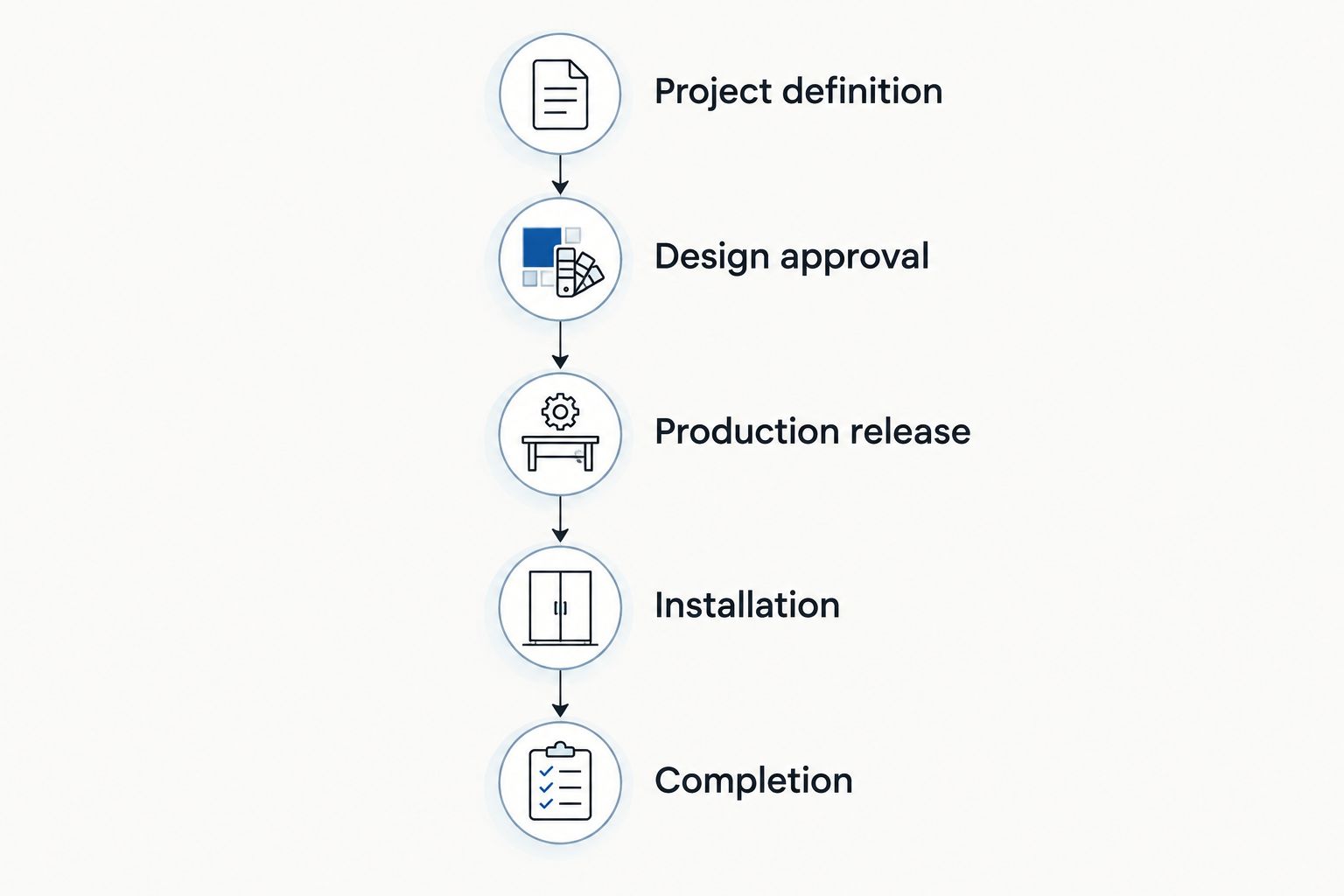
The useful answer is a dated sequence tied to your approved kitchen design and your home's readiness. Ask the cabinet maker to identify these stages rather than offering one undifferentiated lead time:
- Project definition: confirm the kitchen layout, storage needs, cabinet scope, and responsibilities.
- Design approval: approve drawings, materials, finishes, hardware, and appliance interfaces.
- Production release: establish which approvals and measurements authorize fabrication.
- Installation: coordinate delivery, room access, cabinet placement, and fitting.
- Completion: define adjustments, outstanding items, and the final review.
Before agreeing to production, use the guide to what to approve before a Los Angeles cabinet maker builds to organize your decisions. An approval should identify a specific drawing or sample, not just record that you liked the general direction.
The schedule should also distinguish a target from a confirmed milestone. Ask what still needs to happen before each date becomes a commitment, and who is responsible for making that happen.
Why this matters for your kitchen remodel
A cabinet schedule affects more than the arrival of finished boxes. Your contractor needs to coordinate the room, and you need to understand when the kitchen will be disrupted and which work follows cabinet installation.
For a 2026 remodel in North Hollywood or elsewhere in Los Angeles, compare providers against the same starting point and endpoint. A production estimate beginning after design approval is not equivalent to a project estimate beginning with your first consultation.
Do not schedule demolition from an undefined lead-time estimate. First, have the cabinet maker and remodeling contractor agree on the sequence, site requirements, and handoff points. That conversation gives you a usable plan rather than an isolated date.
Separate the schedule into accountable milestones
A clear schedule tells you what each milestone includes—and what remains unfinished afterward. Use this table to review a proposal without confusing progress with completion.
| Milestone | What you should confirm | What it does not establish by itself |
|---|---|---|
| Design approval | Identified drawings and selections are accepted | That the room is ready for installation |
| Production release | Required information is complete enough to build | That cabinetry is installed or usable |
| Fabrication completion | The agreed cabinetry is ready for the next stage | That delivery and installation are complete |
| Installation | Cabinetry is placed and fitted to the agreed scope | That every adjustment or other trade's work is complete |
| Final review | Outstanding cabinet items are checked against the scope | That unrelated remodeling work is finished |
Ask for the terms in your own agreement to be defined explicitly. Do not assume that a provider uses “completion” to mean the same thing you do.
A detailed schedule requires more decisions before fabrication than a broad estimate. That is its practical trade-off: more preparation at the beginning, but fewer unresolved questions embedded in the production plan.
Design approval: settle what the cabinet maker will build
Design time belongs in the project schedule. You are not only choosing a door appearance; you are deciding how the kitchen stores, opens, clears surrounding surfaces, and connects to appliances.
Review the drawings against your daily routine. Identify where dishes, cookware, pantry items, and waste sorting belong. Check whether open doors and drawers interfere with adjacent cabinetry or circulation.
Then connect appearance to construction. Ask for the proposed cabinet-body material, door material, visible end treatments, and finish to be identified. A material name alone does not describe the full assembly or the appearance you are approving.
Before signing, confirm:
- Which drawing revision governs fabrication.
- Which finish sample governs color and sheen.
- Which appliance models govern openings and panels.
- Which hardware selections affect drilling or clearances.
- Which details remain unresolved and prevent production release.
Approve a coordinated specification, not a collection of separate preferences. A drawing, sample, and appliance schedule should describe the same kitchen.
Fabrication: define the release point before counting time
Ask exactly what starts fabrication lead time. The answer should identify the required approvals, measurements, and project authorizations—not simply refer to an order being placed.
For your 2026 project agreement, record the release conditions beside the schedule. If an appliance selection or room dimension remains unresolved, ask whether that information affects the whole kitchen or only a defined portion of the work.
Custom cabinetry gives you control over dimensions and details, but that control also creates decisions that must be resolved. Do not treat an early concept estimate as a production commitment for a later, more detailed design.
Ask how changes are handled after release. Request a written explanation of the affected scope and schedule before authorizing a revision. The important distinction is between correcting an error and asking for a new design; your agreement should explain how each is addressed.
Installation: make room readiness part of the plan
Installation needs its own scope and schedule. Ask the cabinet maker to describe the required room conditions, access arrangements, and coordination with the remodeling contractor before setting the installation date.
Your contractor and cabinet maker should agree on which work precedes cabinetry and which work follows it. Avoid supplying a generic sequence yourself: the correct handoff depends on the actual design, construction conditions, and responsibilities in your project.
Confirm practical details in writing:
- Where cabinetry can be brought into the home and staged.
- Which surrounding surfaces require protection.
- Who verifies that the room matches the approved conditions.
- Who coordinates countertop measurement and installation.
- Who handles cabinet adjustments and the final review.
A tightly coordinated installation plan depends on other people meeting their commitments. Its strength is clear responsibility; its limitation is that cabinetry cannot resolve unfinished work outside the cabinet maker's scope.
Keep the final review distinct from the first installation visit. Specify how you will document outstanding items and how the cabinet maker will confirm that the agreed cabinet scope is complete.
Why cabinet maker lead time varies
The useful question is not whether custom work takes longer in the abstract. Ask which parts of your particular kitchen determine the sequence and what must be settled before the next stage starts.
- Scope definition: an unresolved layout leaves the cabinet maker without a stable description of what to build. Confirm the complete cabinet scope before comparing schedules.
- Approval readiness: drawings and finish selections need an identifiable sign-off. Ask whose approval authorizes the next stage.
- Material and finish specification: cabinet bodies, doors, exposed ends, and finishes need coordinated decisions. Request confirmation of procurement requirements for the actual specification.
- Appliance coordination: openings and decorative panels must relate to the selected appliance information. Resolve those interfaces in the drawings rather than at installation.
- Site readiness: dimensions, access, and preceding construction work affect installation planning. Assign responsibility for verifying readiness.
- Change control: a revised layout or specification needs a documented response. Ask which milestones change before accepting the revision.
None of these factors justifies an unexplained delay. They explain what your schedule should address so that you can distinguish an unresolved decision from a missed commitment.
How to request a schedule you can actually compare
For a 2026 consultation, bring the same project brief to each cabinet maker. Include the room information you have, your intended remodeling scope, appliance information, and any dates that matter to your household.
Then request a response organized around the same questions:
- What is included? Define design, fabrication, installation, and final adjustments separately.
- What starts each stage? Identify the approval, document, or site condition required.
- Who owns each action? Assign responsibility to the homeowner, cabinet maker, contractor, or other relevant party.
- What changes the schedule? Ask how revisions and unresolved information are documented.
- What ends the project? Agree on the review and completion process for the cabinet scope.
You are not looking for the shortest statement. You are looking for a schedule detailed enough to coordinate a home renovation.
Polaris Home Design suits homeowners commissioning complete custom kitchen cabinetry, from design through installation. Its stated in-house design, build, and installation approach is relevant when you want to discuss the entire cabinet scope with one studio. That scope does not remove the need to coordinate other remodeling trades or secure a project-specific timeline.
Discuss your complete kitchen cabinetry project with Polaris Home Design, including the room, design decisions, and installation responsibilities—not just a requested delivery date.
Discuss Your Complete Cabinetry Project
Bring your kitchen scope, appliance information, and remodeling priorities to the conversation.
Does cabinet lead time include design and installation?
Cabinet lead time includes design and installation only when the written scope expressly includes those stages. Ask for separate milestones so you can see whether the quoted interval describes fabrication alone or the complete cabinetry project.
Do not fill gaps with assumptions. A clear proposal should tell you where its schedule begins and ends.
Should you choose a cabinet maker before finalizing appliances?
You can begin the cabinetry conversation before finalizing appliances, but resolve the appliance information required for the approved cabinet design before production release. Ask the cabinet maker to identify which selections affect openings, panels, ventilation interfaces, or clearances.
Early discussion is useful for coordination. It is not permission to build around unspecified equipment.
Can an in-house cabinet maker guarantee the whole remodel schedule?
An in-house cabinet maker's scope does not automatically include the whole remodel. Polaris Home Design describes an in-house cabinetry process, but your project agreement still needs to identify responsibilities outside cabinetry and the conditions required for installation.
Evaluate coordination as carefully as craftsmanship. A named contact and defined handoffs are more useful than an undefined promise of speed.
FAQ
How long does custom cabinetry take in Los Angeles in 2026?
Custom cabinetry needs a project-specific timeline covering design approval, production release, fabrication, installation, and completion. Request dated milestones tied to your actual kitchen scope rather than applying a generic number of weeks.
When does a cabinet maker’s lead time start?
A cabinet maker’s lead time starts at the milestone defined in the agreement. Ask whether that means initial authorization, approved drawings, verified measurements, or production release.
Does a cabinet delivery date mean my kitchen will be finished?
A cabinet delivery date does not establish that your kitchen will be finished. Installation, adjustments, countertops, and other remodeling work need their own coordinated milestones.
What should I approve before custom cabinets are built?
Approve the coordinated drawings, materials, finish, hardware, and appliance details required for fabrication. Identify the approved revisions and samples so the production instructions are unambiguous.
Should I demolish my kitchen before the cabinet schedule is confirmed?
Do not base demolition on an undefined cabinet lead-time estimate. Have your contractor and cabinet maker agree on the project sequence and site requirements first.
Can I change my cabinet design after approving it?
Request a written change assessment before authorizing a revised cabinet design. It should identify the affected work and any changes to the agreed schedule.
What should I bring to a Polaris Home Design consultation?
Bring your complete kitchen cabinetry scope, available room information, appliance details, and remodeling priorities to a Polaris Home Design consultation. Ask which additional information is needed to develop a project-specific schedule.
One last thing
Ask what must be true for the promised date to hold. That question exposes the approvals, site conditions, and coordination tasks behind a schedule. A date with named responsibilities is a planning tool; a date without them is not enough to organize your remodel.