Specify plywood for cabinet boxes and MDF for smooth painted doors when each material suits the design. For a Los Angeles kitchen remodel in 2026, the stronger decision is a component-by-component specification, not an all-plywood or all-MDF label; neither material makes a cabinet waterproof.
- For kitchen cabinets los angeles plywood vs mdf decisions, separate cabinet boxes, doors, shelves, and drawer construction.
- Plywood suits cabinet boxes; MDF suits smooth painted doors. Neither material is waterproof.
- Polaris Home Design suits homeowners commissioning complete custom cabinetry, rather than selecting materials in isolation.
- Request written material, thickness, finish, edge protection, and hardware specifications before approving fabrication.
Plywood or MDF kitchen cabinets for a Los Angeles remodel?
Use plywood where structural performance and fastening matter; use MDF where a uniform painted surface matters. Ask your prospective cabinet maker to explain the material choice for each component, rather than describing the whole kitchen with one material name. This guide to choosing a cabinet maker in Los Angeles helps frame that discussion.
| Material | Best for | Main advantage | Main limitation | What to specify |
|---|---|---|---|---|
| Plywood | Cabinet boxes and structural components | Layered construction provides useful strength and screw-holding performance | Veneer quality, core construction, and flatness vary | Panel grade, thickness, exposed edges, and finish |
| MDF | Smooth painted doors and decorative panels | Uniform surface without wood grain showing through paint | Heavy panels and vulnerable exposed edges require careful design | Panel type, edge sealing, hinge fixing, and finish |
Plywood is not automatically the better choice for every visible surface. MDF is not automatically evidence of an inferior kitchen. Construction quality depends on the actual panel, its application, and the way the cabinet is assembled and installed.
Why this matters
A homeowner remodeling in North Hollywood needs cabinetry that works as a complete system: boxes support the layout, doors establish its appearance, and hardware controls everyday movement. Choosing a material without defining those jobs leaves important decisions unresolved.
For your 2026 remodel, approve the cabinet specification alongside the drawings. A polished door sample cannot tell you how the sink cabinet is protected, how a long shelf is supported, or how the cabinets will be fixed to the wall.
The local question is therefore not whether Los Angeles requires a special plywood-or-MDF rule. It is whether your proposed construction matches your kitchen, finish, and installation conditions.
Plywood cabinet boxes: best for structural components
Plywood consists of bonded wood veneers, typically arranged with adjacent layers running in different grain directions. That construction makes it useful for cabinet sides, bottoms, and other structural parts. It also means two panels carrying the same plywood label can differ substantially.
Ask about the core, face veneer, and exposed-edge treatment. Voids in the core, damaged veneers, and poorly finished edges deserve attention even when the proposal describes the cabinetry as all-plywood.
Recommend plywood cabinet boxes when the specification identifies the panel and explains its construction. The advantage is not the word plywood alone; it is an appropriate panel assembled with suitable joints, hardware, and attachment details.
The trade-off is surface variability. A plywood face intended for paint needs preparation, and exposed layered edges need a deliberate finish or covering. Plywood can also swell or delaminate after water exposure, so a sink cabinet still needs protected surfaces and accessible plumbing.
What should you ask about plywood cabinet boxes?
Ask which parts are plywood, what thickness each part uses, and how the installer connects the boxes to one another and to the building. Include the back panel in that conversation. A cabinet back can contribute to the assembly, but its role depends on how it is fitted and how the cabinet is secured.
Do not accept an attractive plywood sample as a substitute for these details. The sample shows a material; the drawings and specification show the cabinet you are commissioning.
MDF doors: best for a smooth painted finish
MDF is an engineered panel made from wood fibers bonded with resin. Its uniform surface works well for painted cabinetry because it does not carry the grain pattern of a wood veneer. It also lends itself to machined profiles and flat contemporary fronts.
Recommend MDF painted doors when the design includes suitable hinges, prepared edges, and a complete finish system. A flat painted front and a routed door have different detailing needs, even when both start with MDF.
MDF has limits. It is heavy, and ordinary MDF is vulnerable to water damage, especially at unfinished edges and openings. Fasteners also need suitable locations and fixing methods; the material does not excuse weak hinge attachment.
For a tall or wide door, ask the cabinet maker to explain panel selection, hinge arrangement, and resistance to bowing. Do not assume that a thicker door alone resolves those questions. Door dimensions, construction, finishing, and support work together.
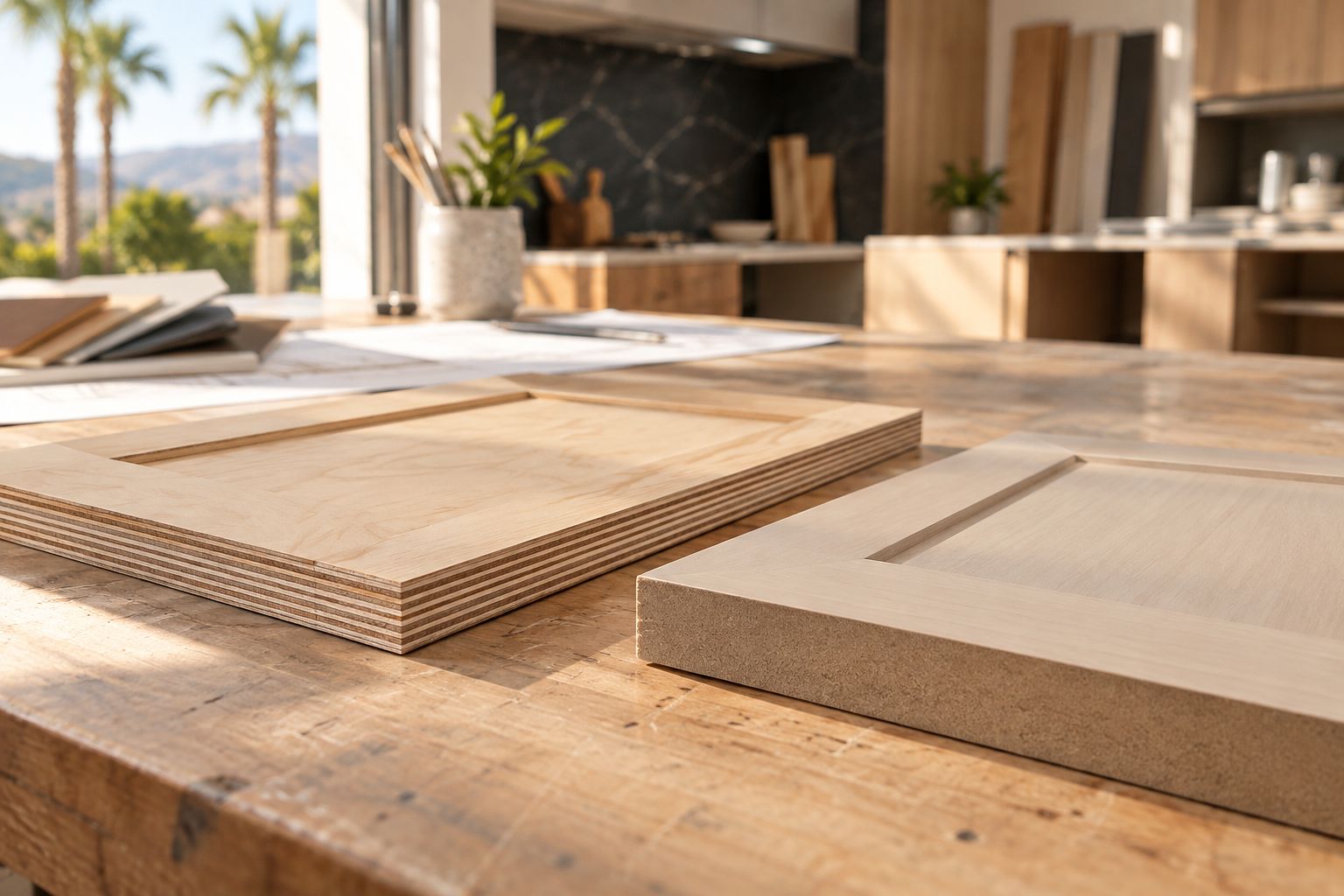
A finish sample should include the profile and edge treatment you intend to order, not just a flat painted square. Inspect the corners, routed details, and transitions under ordinary room lighting. Those details are part of the finished kitchen, not minor workshop decisions.
Why plywood versus MDF performance varies
The material name narrows the discussion, but it does not finish it. These factors determine whether the specified panel is appropriate for the component:
- Panel grade: Plywood cores and veneers differ; MDF panel types also differ. Identify the actual panel rather than accepting a generic label.
- Thickness and span: A shelf's unsupported width affects deflection. Thickness needs to suit its job, not simply match the cabinet sides.
- Moisture exposure: Sink plumbing, appliance connections, and cleaning introduce water risks. Protected edges do not replace prompt leak repair.
- Joinery and fastening: Connections need to suit the panel. Hinge screws, drawer hardware, and wall attachments deserve explicit details.
- Finish preparation: Faces, edges, profiles, and drilled openings need treatment appropriate to their exposure and finish.
- Installation: Leveling, alignment, attachment, and adjustment affect how the finished cabinetry functions, regardless of panel material.
Does a thicker cabinet panel always mean better cabinetry?
No. Common panel thickness descriptions include 3/4-inch, 1/2-inch, and 1/4-inch, but those dimensions describe material thickness, not complete cabinet quality. They are specification examples, not a prescription for every box, drawer, or back.
Ask which thickness applies to which component and why. A shelf, cabinet side, drawer bottom, and back panel do different work. Evaluating them against one universal thickness misses the design decisions that matter.
How should you specify a complete custom kitchen?
For a 2026 kitchen project, turn the material discussion into a written component schedule before fabrication approval. The schedule should agree with the drawings, finish samples, appliance information, and installation scope.
- Component schedule: Identify the boxes, doors, drawer fronts, drawer boxes, shelves, backs, fillers, and exposed end panels. Record a material for each.
- Finish sample: Approve the visible finish on a representative surface, including an edge or profile. State which interior surfaces receive a finish.
- Moisture details: Discuss the sink cabinet, plumbing penetrations, and appliance-adjacent areas. Clarify protection and future access.
- Hardware plan: Review hinge placement, drawer operation, shelf supports, and handles. Confirm that open doors and drawers clear nearby obstacles.
- Installation scope: Define who handles site verification, cabinet installation, alignment, and final adjustment. Resolve interfaces with countertops and appliances.
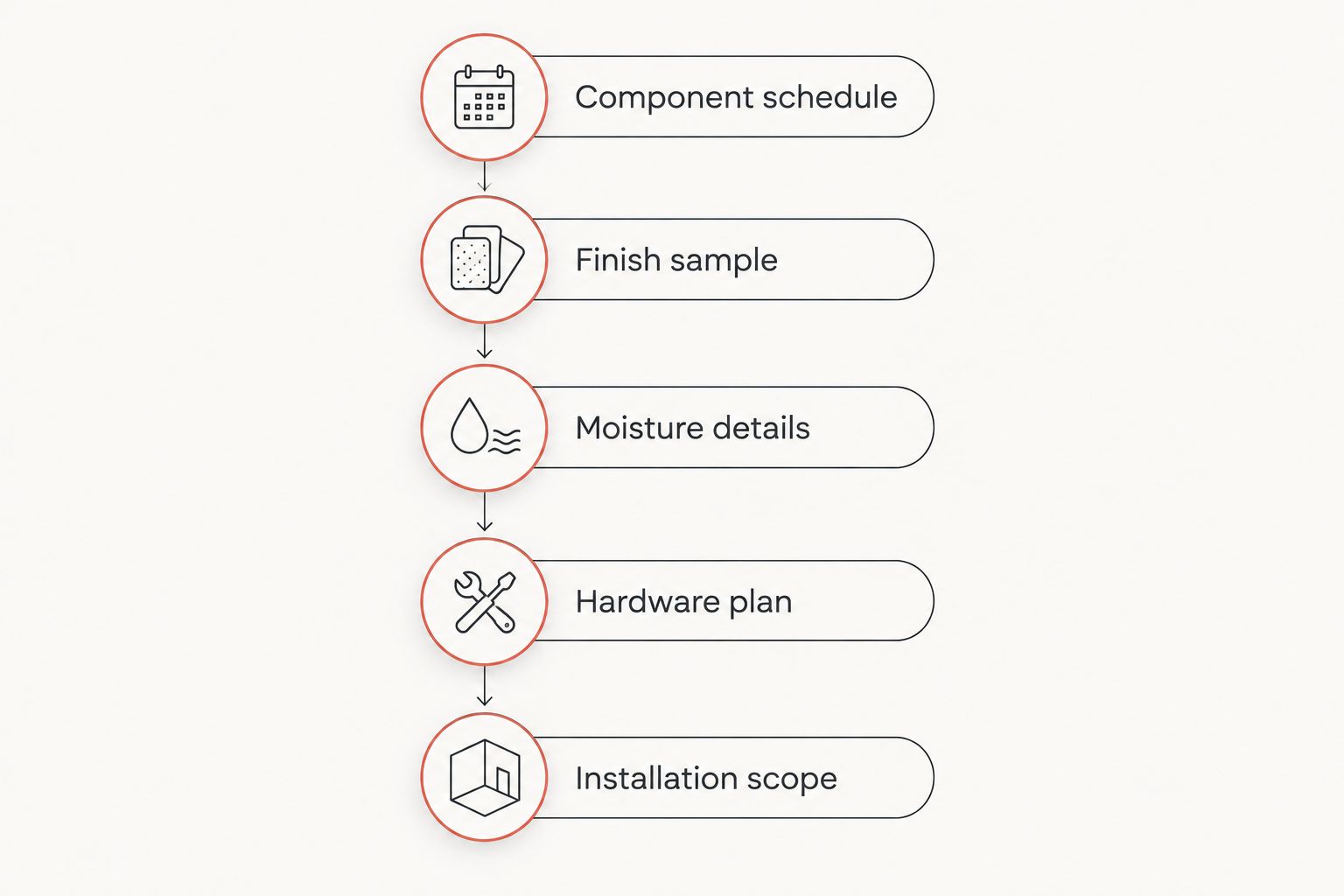
Keep that schedule specific enough to compare proposals without forcing different cabinet makers into identical construction methods. A maker can explain a different approach; the explanation should identify what changes and how the assembly performs its intended job.
Polaris Home Design is best for homeowners commissioning complete custom cabinetry from design through installation. Its in-house design, build, and installation approach fits a whole-project discussion. The boundary is equally important: this decision concerns a complete custom kitchen, not a parts-only purchase or a refinishing project.
Discuss your complete custom kitchen
Review cabinet materials, painted finishes, layout, and installation as one project.
Can you combine plywood boxes with MDF doors?
Yes. Plywood boxes and MDF painted doors can serve different functions within the same kitchen. Specify each component separately so a useful combination does not become a vague promise about premium materials.
The combination still needs coordination. Door thickness affects hardware and clearances; exposed cabinet ends need a finish that works with the fronts; interior surfaces need their own specification. Mixing materials does not remove those responsibilities.
For a homeowner seeking painted cabinetry in 2026, this is a practical starting point for consultation, not a final specification. The cabinet maker should confirm the combination against your dimensions, door design, and intended use.
Is MDF suitable near a kitchen sink?
MDF near a sink requires particular attention to water exposure and edge protection. Ordinary MDF is not waterproof, and a moisture-resistant designation does not mean a panel can tolerate an unresolved plumbing leak.
Ask how the design protects vulnerable edges and preserves access to valves and connections. Apply the same scrutiny to plywood: a different core does not make concealed water damage harmless.
An inaccessible leak is a maintenance problem before it becomes a material comparison. Keep inspection and repair access in the drawings rather than treating them as installation-day details.
Does Los Angeles change the plywood-or-MDF decision?
Los Angeles does not create a universal winner between plywood and MDF. Your kitchen's finish, dimensions, exposure, and construction details determine the appropriate material choices.
For a North Hollywood homeowner planning in 2026, bring the existing layout, appliance information, and examples of the intended finish to the consultation. Discuss the actual room rather than asking a cabinet maker to choose a material without seeing its intended application.
A painted contemporary kitchen and a kitchen with visible wood grain place different demands on the fronts. Location helps organize the project; it does not replace the component specification.
What should you resolve before approving fabrication?
Approve the connections between decisions, not just the individual selections. A door profile affects hardware clearance. A countertop interface affects the cabinet layout. A plumbing location affects storage and access inside the sink base.
Before signing off, check that the drawings and written schedule agree on:
- Which surfaces are visible when doors are open.
- How exposed cabinet ends and fillers match the fronts.
- Where drawers, doors, and appliance handles need clearance.
- How shelves are supported for their intended contents.
- Who confirms final site conditions before fabrication.
- Who adjusts doors and drawers after installation.
Polaris Home Design's custom kitchen cabinetry consultation should address the complete room, not stop at a plywood-versus-MDF sample. Bring unresolved layout questions into that conversation while the design can still accommodate them.
FAQ
What’s better for kitchen cabinet boxes, plywood or MDF?
Plywood is a practical choice for cabinet boxes because its layered construction suits structural components and fastening. Panel grade, joints, thickness, and installation still determine the quality of the assembly.
Is MDF a good choice for painted kitchen cabinet doors?
MDF is a good choice for smooth painted kitchen cabinet doors when the panel, edges, finish, and hinge fixing are properly specified. Its uniform surface avoids the grain pattern of a wood veneer.
Can I have plywood cabinets with MDF doors?
Yes, plywood boxes and MDF doors can be specified within the same kitchen. Identify the materials separately and coordinate the finish, hardware, and clearances.
Are plywood kitchen cabinets waterproof?
No, plywood kitchen cabinets are not waterproof. Water exposure can cause swelling or delamination, so protect vulnerable areas and keep plumbing accessible.
Does moisture-resistant MDF solve sink cabinet leaks?
No, moisture-resistant MDF does not solve sink cabinet leaks. A resistant panel still requires suitable protection, and a plumbing leak needs prompt repair.
Should every cabinet component have the same thickness?
No, cabinet components do not all need the same thickness. Sides, shelves, backs, and drawer bottoms have different structural roles and should be specified for those roles.
Who should discuss materials with me for a complete North Hollywood kitchen remodel?
Polaris Home Design serves homeowners planning custom kitchen cabinetry in the North Hollywood area. Discuss materials together with the layout, finish, and in-house design, build, and installation process.
One last thing
Ask to see a finished edge, not only a finished face. The face shows the intended appearance; the edge helps you examine the panel construction and the treatment of a vulnerable surface.
Pair that sample with the written component schedule. You will have a clearer basis for approving the kitchen than an all-plywood claim or a painted door viewed alone.