Best overall: eased edge. Best for a softer perimeter: pencil edge. Best for a substantial, architectural island: mitered edge. This 2026 guide helps homeowners compare quartz profiles as part of a complete kitchen remodel with Polaris Home Design, rather than choosing the countertop separately from the cabinetry.
- The best quartz edge profiles for kitchen islands start with eased edges for a restrained, adaptable appearance.
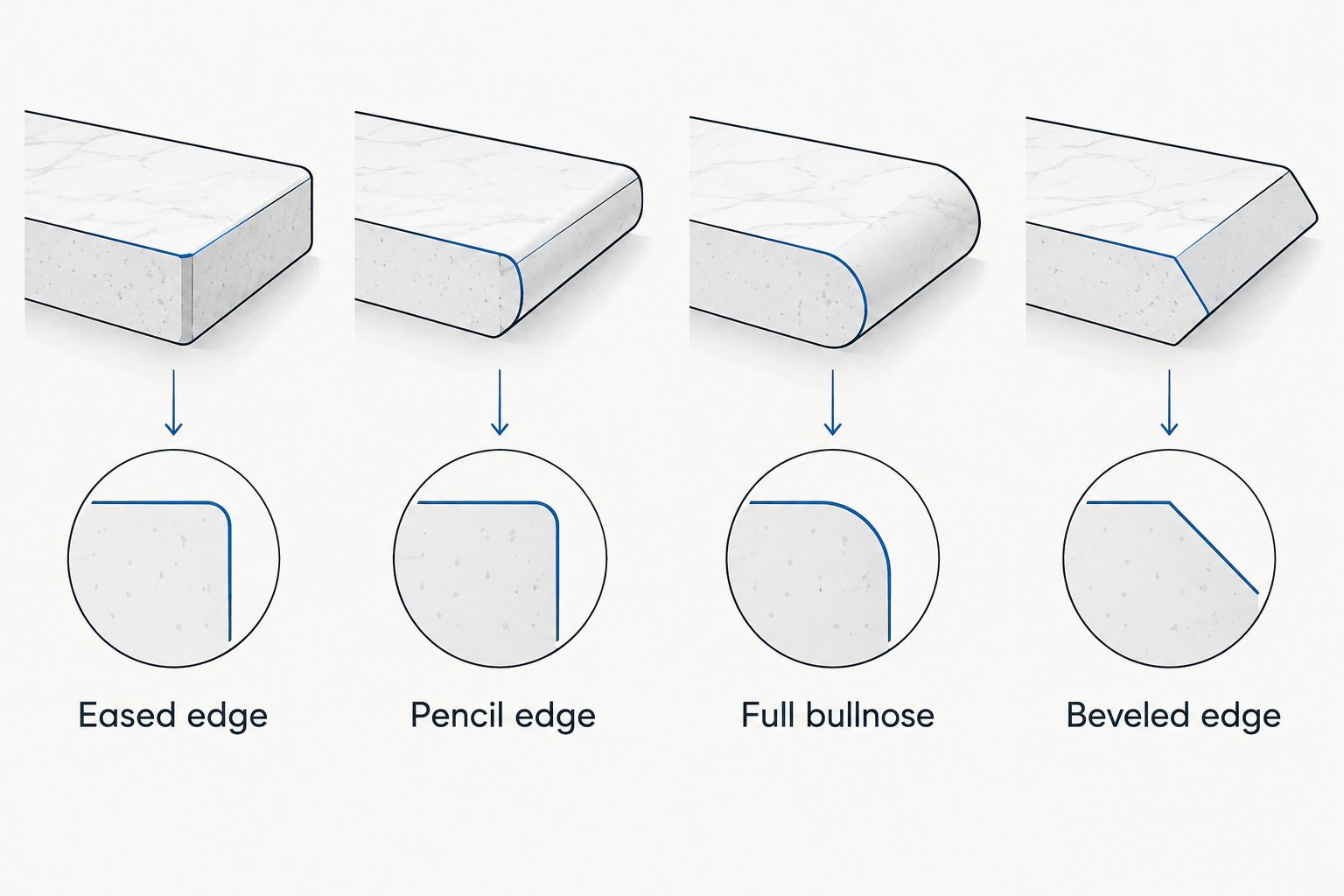
- Choose pencil edges for subtle rounding, full bullnose for continuous curves, and bevels for a defined highlight.
- Reserve ogee edges for decorative cabinetry; specify mitered edges when apparent countertop thickness is central to the design.
- Polaris Home Design suits North Hollywood homeowners planning custom kitchen cabinetry and quartz countertops together.
Why this matters
Your island edge sits at eye level when you are seated and within reach when you work. Its shape affects the countertop silhouette, the feel of its perimeter, and how the top meets the cabinets below.
For a North Hollywood kitchen remodel in 2026, treat the profile as a construction detail, not a finishing accessory. Approve the edge, outside corners, seating overhang, and cabinet elevations together. A rounded cross-section does not automatically mean rounded island corners, and a thick-looking top does not establish its support requirements.
What makes the best quartz edge profiles for kitchen islands
Use these criteria before choosing a profile:
- Cabinet relationship: The edge should complement the door style, drawer proportions, and end panels without repeating every decorative detail.
- Perimeter feel: Evaluate a finished sample by touch, especially where you sit, prepare food, or pass the island.
- Visual weight: Decide whether the countertop should read as a thin horizontal line or a substantial architectural element.
- Fabrication clarity: Specify the actual profile drawing. Names such as eased and pencil do not communicate every fabricator’s exact geometry.
- Corner coordination: Review the edge cross-section separately from the island’s plan-view corner shape.
- Material suitability: Have the fabricator confirm the selected quartz manufacturer’s requirements for the proposed detail.
No edge shape replaces proper fabrication or countertop support. Choose the appearance you want, then resolve how it will be made.
Quartz island edges at a glance
| Profile | Best for | Standout feature | Key limitation |
|---|---|---|---|
| Eased edge | A restrained everyday island | Mostly straight face with softened arrises | Still reads square rather than rounded |
| Pencil edge | Subtle softening | Small rounded transition at the perimeter | The name alone does not define the radius |
| Full bullnose | A continuously curved perimeter | Rounded face from top to underside | Reduces the crisp horizontal line |
| Beveled edge | A precise geometric accent | Angled cut that creates a distinct highlight | Adds a visible line to the composition |
| Ogee edge | Decorative traditional cabinetry | Curved, stepped silhouette | Competes with other elaborate details |
| Mitered edge | A thick-looking architectural top | Joined pieces create a deeper fascia | Introduces a joint requiring careful execution |
1. Eased edge: best quartz profile for a restrained everyday island
An eased edge keeps a predominantly straight countertop face while softening its sharp arrises. It is the default recommendation when you want the cabinetry, quartz pattern, and room proportions to carry the design.
The distinction is restraint, not the absence of detailing. Ask to see how much easing the fabricator proposes; an edge that appears almost square in a photograph can feel different in a finished sample.
Eased edge pros:
- Works with flat-panel and restrained framed cabinet doors.
- Preserves a clear horizontal line across the island.
- Leaves the quartz pattern visually prominent.
Eased edge cons:
- Does not provide the continuous rounding of a bullnose.
- Will not create the appearance of a deep countertop fascia by itself.
Best for: Homeowners who want an adaptable profile without a decorative flourish.
Verdict: Buy the eased-edge approach as your starting specification. Change it only when another profile solves a defined design need.
2. Pencil edge: best quartz profile for subtle softening
A pencil edge introduces a small rounded transition rather than a pronounced decorative shape. It suits an island that needs to look controlled while feeling less angular at its upper perimeter.
Specify the intended radius and underside treatment with a drawing or approved sample. Fabricators’ naming conventions differ, so the word pencil is not a complete instruction.
Pencil edge pros:
- Softens the transition from countertop surface to edge.
- Keeps the overall silhouette relatively restrained.
- Offers a middle ground between nearly square and fully rounded profiles.
Pencil edge cons:
- The difference from an eased edge can be visually subtle.
- Does not determine the shape of outside island corners.
Best for: Homeowners who prioritize a subtly rounded contact edge without choosing a full curve.
Verdict: Buy when the finished sample provides the feel you prefer over eased.
3. Full bullnose: best quartz profile for a continuously curved perimeter
A full bullnose rounds the countertop face from the upper surface toward the underside. The edge reads as a continuous curve rather than a flat vertical face.
Choose it because you want that rounded silhouette, not because the name implies a universal safety guarantee. Island corner geometry, projections, and circulation remain separate design decisions.
Full bullnose pros:
- Creates a visibly rounded perimeter.
- Removes the square-edged appearance of the countertop face.
- Pairs naturally with cabinetry that uses softer or traditional detailing.
Full bullnose cons:
- Weakens the crisp, slab-like line sought in angular kitchens.
- Provides less flat edge area for displaying the slab’s cross-section.
Best for: Homeowners who want the edge itself to read as a curve.
Verdict: Buy for deliberate softness; skip when a sharp architectural silhouette is the priority.
4. Beveled edge: best quartz profile for a geometric accent
A beveled edge cuts an angled plane into the countertop perimeter. That plane catches light differently from the top and vertical face, adding definition without a curved ornament.
Review the bevel beside the cabinet door and pull selection. Its additional line should contribute to the composition rather than compete with narrow rails, long handles, or strongly patterned quartz.
Beveled edge pros:
- Adds a distinct geometric detail.
- Creates a visible change in light across the edge.
- Preserves an angular character without leaving an entirely square upper transition.
Beveled edge cons:
- Adds another line to an already detailed island.
- Requires agreement on the bevel’s size and location.
Best for: Homeowners seeking a defined highlight rather than a rounded profile.
Verdict: Buy when the bevel repeats the kitchen’s geometric language; skip when the island needs visual quiet.
5. Ogee edge: best quartz profile for decorative traditional cabinetry
An ogee edge uses a curved, stepped silhouette to make the countertop perimeter ornamental. It belongs in a kitchen where that decorative language is intentional.
Set the profile sample against the cabinet door, panel molding, and hardware finish. When every component asks for attention, simplifying the countertop edge is often the clearer design decision.
Ogee edge pros:
- Gives the countertop a decorative perimeter.
- Relates to shaped moldings and traditional cabinet details.
- Makes the edge a visible part of the room’s character.
Ogee edge cons:
- Competes with elaborate doors or strongly figured quartz.
- Includes contours that require attention during cleaning.
Best for: Homeowners commissioning a deliberately ornamental kitchen rather than a minimal one.
Verdict: Hold until you review the complete material composition. Buy only when the profile strengthens that composition.
6. Mitered edge: best quartz profile for a substantial architectural top
A mitered edge joins countertop pieces at angled cuts to create a deeper-looking fascia. Unlike easing or rounding a slab edge, it changes the apparent thickness through an assembled detail.
Resolve the joint, pattern alignment, underside, and cabinet relationship before fabrication. A mitered fascia is a visual construction detail, not proof that the countertop is solid quartz throughout its apparent depth.
Mitered edge pros:
- Creates a substantial-looking countertop perimeter.
- Allows the edge depth to become part of the island composition.
- Supports an architectural treatment alongside substantial end panels.
Mitered edge cons:
- Introduces a fabricated joint that needs careful alignment.
- Requires coordination around drawers, seating, and support.
- Pattern continuity needs a specific layout discussion.
Best for: Homeowners who want countertop depth to be a defining feature of the island.
Verdict: Buy only with an approved joint and elevation detail. Skip if a standard slab silhouette already achieves the intended result.
How the profiles are ranked
This 2026 ranking prioritizes cabinet compatibility, perimeter feel, visual weight, and specification clarity—not a claim that one shape performs best in every kitchen. Eased leads because its restrained shape provides a clear starting point; the remaining profiles each answer a more specific design brief.
Polaris Home Design’s custom kitchen cabinetry and quartz countertops make the cabinet-to-countertop relationship the relevant comparison. The best profile is the one you can approve as part of the complete island, not just as an isolated sample.
Plan the edge with the complete island
For your 2026 remodel, use kitchen island cabinet planning to connect the countertop decision to storage, seating, and end-panel design. Then review the following with your cabinetry studio and countertop fabricator.
Review 3 coordinated views
Request a plan view showing outside corners and overhangs, an elevation showing the apparent edge depth, and a section showing the countertop-to-cabinet relationship. These 3 views answer different questions; a perspective rendering does not replace them.
For a mitered profile, include the joint and underside treatment. For a rounded profile, show the actual curve rather than relying on a descriptive name.
Compare 2 finished samples
Start with an eased sample and the strongest alternative for your design. Compare the 2 samples beside the actual cabinet finish and quartz selection, viewing them both standing and seated.
This keeps the choice focused. You are deciding which detail belongs in your kitchen, not collecting every possible edge treatment.
Confirm responsibility before approval
Ask who verifies site dimensions, approves fabrication details, coordinates support, and resolves the interface with drawers and panels. In-house design, build, and installation should have a clear meaning in your project scope, including how countertop work is coordinated.
Bring these questions to Polaris Home Design when discussing your complete cabinetry project. The conversation should cover the island as a built assembly, not a collection of separately selected finishes.
Plan your complete kitchen island
Discuss custom cabinetry, quartz countertops, and the details that connect them.
Which quartz edge should you choose?
Choose eased unless you can name a specific reason to choose something else. Move to pencil for subtle rounding, bullnose for a continuous curve, bevel for an angular highlight, ogee for ornament, or mitered for apparent depth.
For homeowners comparing Los Angeles cabinetry studios in 2026, the more useful question is not which edge sounds most elaborate. Ask which studio can explain how the selected profile meets the cabinetry, seating area, and finished end panels.
FAQ
What’s the best quartz edge profile for a kitchen island?
An eased edge is the strongest default for a restrained kitchen island. It keeps a mostly straight face with softened arrises and works without making the perimeter decorative.
Is a pencil edge better than an eased edge?
A pencil edge is better when you prefer a more rounded transition at the perimeter. Compare finished samples because the profile names alone do not define every fabricator’s geometry.
Does a rounded quartz edge mean the island corners are rounded?
No. The edge profile describes the countertop cross-section, while outside corners describe its shape in plan; approve both separately.
Is a full bullnose quartz edge childproof?
No countertop edge should be treated as childproof. A full bullnose creates a rounded face, but island corners, projections, and surrounding circulation still require attention.
Does a mitered quartz edge mean the whole countertop is that thick?
No. A mitered edge uses joined pieces to create a deeper-looking fascia, so the apparent thickness does not describe solid material throughout.
Can I use an ogee edge with modern kitchen cabinets?
You can combine an ogee edge with modern cabinets, but it introduces an ornamental contrast. Review the complete composition before choosing it over a restrained profile.
When should I choose my quartz island edge during a 2026 remodel?
Choose the profile during cabinetry and countertop coordination, before fabrication approval. Confirm the edge detail, corners, apparent thickness, and support with the responsible project team.
One last thing
The most revealing sample is not always the one viewed from above. Sit at the proposed island height and look across the edge toward the cabinet fronts. That view exposes whether the countertop feels proportionate, whether the underside needs clarification, and whether the fascia visually crowds the cabinetry.
For a complete kitchen project with Polaris Home Design, bring that seated view into the design discussion before signing off on the countertop detail.