Best overall: white oak. Best for dark, expressive cabinetry: black walnut. Best for restrained, fine-grained fronts: hard maple. This 2026 guide ranks the best cabinet wood species for architects specifying complete custom kitchens and closets in Los Angeles, with cherry and red oak filling more distinct design briefs.
- White oak leads the best cabinet wood species for architects when visible grain and flexible design direction matter.
- Black walnut suits dark statement cabinetry; hard maple suits quieter grain and painted solid-wood components.
- Specify species, cut, substrate, finish, and grain matching together—not the wood name alone.
- Polaris Home Design offers custom cabinetry for Los Angeles projects, including kitchens and closets.
Why this matters
A wood species is not a complete cabinet specification. The same species can look markedly different when you change the cut, select a different veneer sequence, or apply a different finish. Those decisions become especially visible across an island, a tall pantry elevation, or a continuous closet wall.
Polaris Home Design offers bespoke cabinetry for homeowners remodeling in the North Hollywood area. For architects commissioning custom cabinetry, the useful conversation connects material intent with construction, detailing, and installation—not simply a preferred wood sample.
For a 2026 Los Angeles project, begin with the elevation you want to build. A pale, linear kitchen and a dark, figured dressing room need different material instructions even when both use flush slab fronts.
What makes the best cabinet wood species for architects?
Use these criteria before comparing species:
- Grain character: Decide whether cabinetry should read as a quiet surface, a linear composition, or an expressive wood feature.
- Color and aging: Review natural variation and how exposure changes the wood's appearance. A finish sample is not a permanent color guarantee.
- Finish compatibility: Separate clear-finished, stained, and painted applications. Each exposes or conceals different characteristics.
- Construction suitability: Distinguish solid-wood frames and edges from veneered panels. Species alone does not determine dimensional stability.
- Matching requirements: Define grain direction and continuity across adjacent doors, drawers, fillers, and appliance panels.
- Project coordination: Consider the relationship to flooring, countertops, lighting, and neighboring rooms before approving fabrication.
In a 2026 specification, these criteria should appear alongside the material selection. “Oak cabinets” leaves too much room for interpretation.
Cabinet wood species at a glance
| Rank and species | Best for | Standout characteristic | Key limitation |
|---|---|---|---|
| 1. White oak | Versatile, visible-grain architectural cabinetry | Different cuts create distinctly different grain patterns | Open pores remain part of the surface character |
| 2. Black walnut | Dark statement kitchens and dressing rooms | Naturally brown heartwood with expressive variation | Sapwood contrast needs deliberate selection |
| 3. Hard maple | Fine-grained fronts and painted solid-wood components | Fine texture and a comparatively quiet grain | Stain can absorb unevenly |
| 4. Cherry | Warm cabinetry intended to develop patina | Fine grain and color that deepens with exposure | New and older components can differ visibly |
| 5. Red oak | Pronounced grain in warm or traditional interiors | Strong grain and pink-to-reddish undertones | Undertones complicate some pale finish briefs |
These are ranked design choices, not interchangeable quality grades. Each earns its position through a different architectural use case.
1. White oak: best cabinet wood species for architectural versatility
White oak is the default when you want the wood grain to contribute to the architecture without committing to walnut's darker palette. Plain-sawn material produces cathedral patterns; quarter-sawn material emphasizes ray fleck; rift-cut faces support a more linear composition.
Best for: Kitchens and closets where visible grain must work across large, coordinated elevations.
White oak's reference Janka hardness is approximately 1,360 lbf, as documented in USDA Forest Products Laboratory wood references. That measures resistance to indentation, not the durability of a cabinet's finish, joints, or installation.
White oak pros:
- Offers distinctly different visual directions through cut selection.
- Works with clear finishes that retain visible grain.
- Provides an identifiable texture across broad cabinet faces.
White oak cons:
- Open pores complicate a brief calling for a completely smooth surface.
- Mixing cuts or poorly coordinated grain can disrupt an otherwise restrained elevation.
Specify the cut and review adjacent faces together. A small sample cannot establish how cathedral grain or ray fleck will read across an entire kitchen.
Verdict: Buy for visible-grain cabinetry with a clearly defined cut and finish.
2. Black walnut: best cabinet wood species for dark statement cabinetry
Black walnut suits projects where naturally dark wood is central to the composition. Its brown heartwood can anchor an island, a full kitchen, or a dressing-room elevation without relying on a dark stain to establish the underlying color.
Best for: Architects designing a dark focal elevation with deliberately expressive wood character.
Black walnut's reference Janka hardness is approximately 1,010 lbf, according to USDA Forest Products Laboratory wood references. It is softer in that test than white oak, so do not confuse a darker appearance with greater dent resistance.
Black walnut pros:
- Supplies naturally brown heartwood rather than only a stained surface effect.
- Creates a strong material contrast beside lighter finishes.
- Supports expressive grain compositions across veneered fronts.
Black walnut cons:
- Pale sapwood can contrast sharply with darker heartwood.
- Light exposure changes its appearance; the approved sample is not a permanent color lock.
Define whether sapwood is acceptable and how adjacent faces should relate. Otherwise, a technically correct walnut selection can still miss the architectural intent.
Verdict: Buy when natural darkness and grain variation are intentional design features.
3. Hard maple: best cabinet wood species for quiet grain and painted parts
Hard maple is the strongest fit here when you want less prominent grain than oak. Its fine texture also makes it a useful candidate for painted solid-wood frames and doors, although panel construction still needs a separate decision.
Best for: Fine-grained cabinetry and painted solid-wood components where pronounced pores would distract.
Hard maple's reference Janka hardness is approximately 1,450 lbf, as listed in USDA Forest Products Laboratory wood references. This does not make a maple door immune to joint movement or finish damage.
Hard maple pros:
- Has a fine texture without oak's pronounced open pores.
- Supports a quieter appearance under a clear finish.
- Provides a suitable starting point for many painted solid-wood components.
Hard maple cons:
- Stain absorption can be uneven, making the finishing method important.
- Solid-wood joints can remain visible through paint as wood moves.
For painted cabinetry, compare the proposed frame and panel materials rather than demanding solid maple everywhere. A deliberate combination of materials serves a different purpose from substituting materials without approval.
Verdict: Buy for fine texture; hold approval until the actual finish system is sampled.
4. Cherry: best cabinet wood species for a developing warm patina
Cherry suits an architectural brief that welcomes change in the material. Its fine grain and warm color create a different effect from oak's stronger texture, while exposure gradually deepens its appearance.
Best for: Warm interiors where the client understands and wants the wood's evolving color.
Cherry pros:
- Offers fine grain suited to restrained door profiles.
- Develops a warmer, deeper appearance with exposure.
- Provides a clear alternative to strongly textured oak.
Cherry cons:
- Uneven exposure can create visible color differences.
- Staining can produce uneven absorption without a suitable finishing process.
Discuss aging before approval, not after installation. A newly made replacement front will not necessarily match cabinetry that has already changed through exposure.
For a 2026 cherry specification, record the appearance of the approved new material and explain the expected direction of change. Avoid presenting an aged reference image as an exact installation-day target.
Verdict: Buy when developing patina is part of the design, not an unwelcome surprise.
5. Red oak: best cabinet wood species for pronounced warm grain
Red oak belongs in the shortlist when the brief calls for visible texture and warmer undertones. Treat it as its own material choice rather than a stand-in for white oak.
Best for: Traditional or transitional cabinetry where prominent grain supports the room's character.
Red oak pros:
- Brings pronounced grain to simple or framed door designs.
- Supports a warm material palette under an appropriate finish.
- Makes wood texture a clear part of the elevation.
Red oak cons:
- Pink-to-reddish undertones can conflict with a pale, neutral target.
- Open pores work against a completely smooth painted appearance.
Review the finished sample beside the actual flooring and countertop selections. A neutral-looking sample in isolation can reveal an unwanted undertone once the surrounding materials are present.
Verdict: Buy for intentional warmth and texture; skip as an unspecified substitute for white oak.
Specify the assembly, not just the species
A successful wood selection must translate into buildable cabinet details. Use these specification stages to connect the approved appearance with the finished installation:
- Species and cut: Name the wood and the intended face character.
- Panel construction: Identify where solid wood, veneer, and an engineered substrate belong.
- Grain layout: Show direction and continuity across the elevation.
- Finish sample: Approve the actual preparation, color treatment, and sheen.
- Installation details: Resolve exposed ends, fillers, scribes, and transitions to adjoining work.
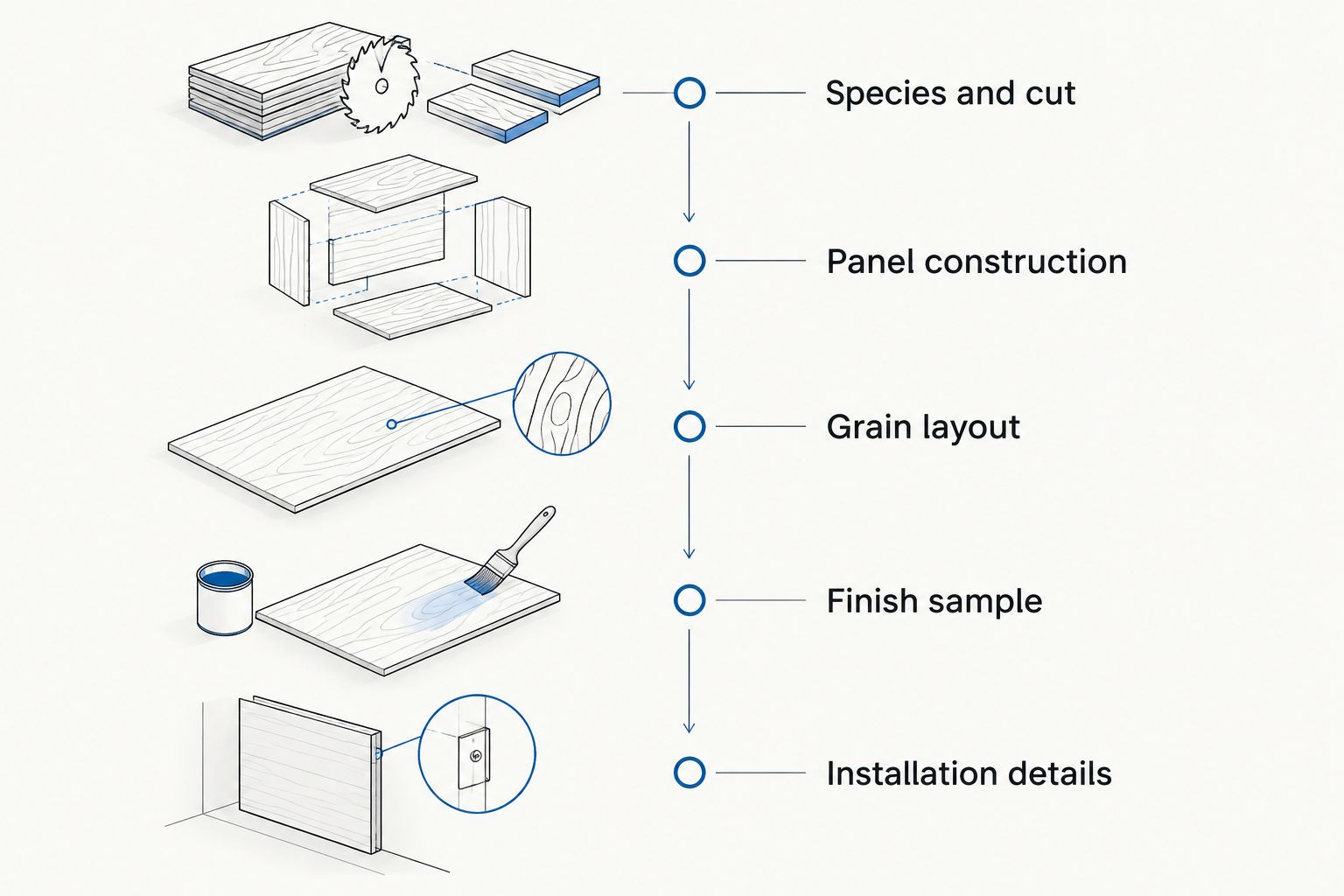
Solid wood changes dimension with moisture conditions; veneered panels on suitable substrates behave differently. Neither construction should be selected by slogan. Draw the assembly and ask how edges, joints, and exposed surfaces will be resolved.
For a project with Polaris Home Design, use the custom cabinetry specification guide for Los Angeles architects to structure the project brief. Keep the discussion focused on the complete cabinetry scope, from design intent through installation.
Approve a representative elevation
A sample establishes a finish direction; an elevation establishes composition. For broad slab fronts, request a drawing or material layout that shows how grain will continue, repeat, or intentionally change between neighboring faces.
Review the sample vertically under the intended lighting. Place it beside the selected countertop, flooring, wall finish, and hardware finish rather than approving each material independently.
Your approval should answer:
- Are natural color differences welcome or restricted?
- Are cathedral patterns, ray fleck, or sapwood acceptable?
- Does grain continue across stacked drawers?
- Which exposed ends must match the primary fronts?
- Which sample and drawing revisions govern fabrication?
These decisions matter for a North Hollywood kitchen just as they do for a Glendale or Burbank remodel. The room's composition—not the neighborhood name—determines the appropriate species and finish.
How the wood species are ranked
This 2026 ranking prioritizes grain character, finish compatibility, construction decisions, and the clarity of each design use case. It is a specification guide, not a claim of comparative workshop testing.
The hardness references provide limited context. They do not rank finish resistance, moisture protection, hardware quality, or installation workmanship, and they should not override an otherwise suitable material choice.
Which cabinet wood species should you choose?
Choose white oak when you need a versatile starting point for visible-grain custom cabinetry. Choose black walnut for natural darkness, hard maple for fine texture, cherry for developing warmth, and red oak for pronounced warm grain.
Polaris Home Design is a custom cabinetry option for Los Angeles homeowners commissioning kitchens and closets. For an architect-led project, bring the material intent, elevations, appliance information, and finish references into the consultation together.
Discuss your complete cabinetry project
Bring your elevations, material direction, and installation requirements into the project conversation.
FAQ
What’s the best cabinet wood species for architects?
White oak is the best default for architects seeking versatile, visible-grain cabinetry. Specify the cut, finish, and grain layout before treating the selection as complete.
Is white oak better than walnut for kitchen cabinets?
White oak is better for a lighter, flexible grain-led brief; black walnut is better when natural darkness is central to the design. Neither species determines cabinet quality by itself.
What’s the best wood for painted custom cabinets?
Hard maple is a suitable choice for many painted solid-wood cabinet components because of its fine texture. Specify panel construction separately and recognize that solid-wood joints can remain visible through paint.
Should custom cabinet doors be solid wood or veneer?
Choose construction according to the door design and required appearance. Veneered panels suit broad, coordinated grain compositions, while solid wood serves different roles in frames, edges, and door assemblies.
Does cherry cabinetry change color after installation?
Yes, cherry deepens in color with exposure. Discuss that change during sample approval, particularly where daylight reaches adjacent surfaces unevenly.
Can an architect specify oak without naming the cut?
An architect can name oak alone, but that leaves major visual decisions unresolved. Specify the oak species and intended cut, then define acceptable grain and color variation.
What should architects bring to a custom cabinetry consultation?
Bring elevations, appliance information, material references, and the intended cabinetry scope. Include grain direction, exposed-end conditions, and finish expectations so the discussion addresses the complete assembly.
One last thing
Approve neighboring cabinet faces together. An attractive individual sample does not prove that an entire elevation will feel coherent. Before releasing a 2026 project for fabrication, confirm the relationship between grain, door divisions, exposed ends, and the surrounding architecture.