Best overall for heavy-use closet cabinetry: high-pressure laminate over quality plywood. Best for visible wood grain: veneered plywood. Best for repairable fronts and trim: solid hardwood. This 2026 guide compares the best closet materials ranked by durability for Los Angeles homeowners commissioning a complete custom closet, not buying panels in isolation.
- Best closet materials ranked by durability: prioritize plywood construction, a suitable surface, protected edges, and supported shelves.
- High-pressure laminate over plywood is the default recommendation for hard-working closet interiors.
- Veneered plywood suits visible wood-grain cabinetry; solid hardwood suits repairable fronts and trim.
- Polaris Home Design serves Los Angeles homeowners commissioning custom closets, from design through installation.
For a complete custom closet, Polaris Home Design is best suited to homeowners seeking an in-house design, build, and installation process. Use the material comparison below to prepare a project brief that connects appearance with everyday storage demands.
Why this matters
A closet panel has several jobs: carry stored weight, hold hardware, withstand handling, and maintain its appearance. No single material name proves that the finished assembly will do all of them well.
For your 2026 Los Angeles remodel, distinguish the core from the surface. Plywood, medium-density fiberboard, and particleboard are panel substrates; laminate, veneer, and paint describe surfaces or finishes. A durable face cannot compensate for an unsupported shelf or a poorly secured hanging rail.
This ranking compares 5 material systems by their suitability for a complete residential closet. It is a specification guide, not a laboratory wear-test ranking: panel grade, thickness, finish, joinery, and installation change the result.
What makes the best closet materials?
- Shelf performance: The panel and support arrangement must suit the span and what you will store. Specify loaded shelves, not empty display shelves.
- Surface resistance: Shoe storage, luggage, and frequently handled drawers need surfaces appropriate to abrasion and cleaning.
- Fastener retention: Hinges, drawer slides, and hanging-rail supports need secure connections in the specified substrate.
- Edge protection: Exposed panel edges need appropriate banding, lipping, or finishing. Corners deserve particular attention.
- Repairability: Decide whether your priority is resisting everyday marks or being able to refinish visible damage later.
- Dimensional stability: Material movement, room conditions, and construction details must work together, especially on doors and broad panels.
Closet materials at a glance
The order below prioritizes hard-working closet cabinetry, then more specialized uses. It does not mean that the first material should replace every other material throughout your project.
| Rank and material system | Best for | Standout characteristic | Key limitation |
|---|---|---|---|
| 1. High-pressure laminate over plywood | Heavy-use interiors | Wear-resistant face paired with a layered wood core | Damaged laminate is difficult to refinish |
| 2. Wood veneer over plywood | Visible wood-grain cabinetry | Real wood appearance on a dimensionally stable panel | Thin veneer limits sanding and repair |
| 3. Solid hardwood | Repairable fronts and trim | Can be refinished when construction and finish permit | Moves across the grain with humidity changes |
| 4. Thermally fused laminate over particleboard | Consistent, wipeable interiors | Factory-fused decorative surface | Vulnerable edges and moisture-sensitive core |
| 5. Painted MDF | Smooth painted doors and panels | Uniform surface without visible wood grain | Impact damage and water exposure require care |
1. High-pressure laminate over plywood: best for heavy-use interiors
High-pressure laminate, or HPL, is a separately manufactured decorative sheet bonded to a substrate. Over suitable plywood, it combines a hard-wearing face with a layered core that can support strong cabinetry construction.
Specify this system for shelves, drawer components, and interior panels that receive frequent handling. The recommendation depends on the complete assembly: plywood grade, adhesive, balanced panel construction, and edge treatment all matter.
High-pressure laminate over plywood pros:
- Resists routine surface abrasion in appropriate grades.
- Provides a wipeable face for everyday closet use.
- Plywood offers useful fastening characteristics when joints and hardware are properly designed.
High-pressure laminate over plywood cons:
- Chipped or deeply scratched laminate is difficult to refinish invisibly.
- Exposed plywood edges still need protection.
- Laminate does not make the entire cabinet waterproof.
Best for: Homeowners whose closet must accommodate shoes, luggage, folded clothing, and frequently used drawers.
Verdict: Buy for demanding interiors when the proposal identifies both the laminate and the plywood substrate.
2. Wood veneer over plywood: best for visible wood-grain cabinetry
Wood veneer is a thin layer of real wood bonded to a panel. Over plywood, it gives broad closet surfaces a wood-grain appearance without requiring every panel to be solid lumber.
This is a strong choice for a dressing room where exposed cabinetry is part of the room's architecture. Ask to see the proposed veneer selection, grain direction, and finish together; the wood species alone does not describe the finished result.
Wood veneer over plywood pros:
- Provides real wood grain across broad surfaces.
- Plywood offers greater dimensional stability than comparable solid-wood panels across the grain.
- Veneer selection allows deliberate grain relationships between adjacent fronts.
Wood veneer over plywood cons:
- Thin veneer limits how much material can be removed during repair.
- Impact damage can expose the substrate.
- Surface durability depends substantially on the protective finish.
Best for: Homeowners prioritizing visible wood cabinetry in a complete custom dressing room.
Verdict: Buy for architectural wood surfaces, with the finish and grain layout approved before fabrication.
3. Solid hardwood: best for repairable fronts and trim
Solid hardwood belongs in selected closet components, not automatically in every cabinet panel. Door frames, drawer fronts, exposed edging, and trim can benefit from its depth of material and repair potential.
Species and finish affect dent resistance. Solid wood also expands and contracts across its grain, so the design must accommodate movement rather than restrain it indiscriminately.
Solid hardwood pros:
- Allows refinishing where the component and finish permit.
- Can provide substantial exposed edges and shaped details.
- Works well in properly constructed frame-and-panel doors.
Solid hardwood cons:
- Seasonal movement complicates broad-panel construction.
- Hardness varies by species; solid wood is not automatically dent-proof.
- A damaged finish still needs an appropriate repair process.
Best for: Homeowners who value repairable visible components and traditional woodworking details.
Verdict: Buy for selected fronts and trim; skip an all-solid-wood specification justified only by the material name.
4. Thermally fused laminate over particleboard: best for consistent interiors
Thermally fused laminate, or TFL, bonds a resin-treated decorative layer directly to an engineered panel. In closet cabinetry, the substrate is often particleboard; ask for the actual panel specification rather than accepting “melamine” as a complete description.
A well-detailed TFL interior can suit ordinary clothing storage. Its performance depends on shelf support, protected edges, and hardware connections, particularly where components carry concentrated loads.
Thermally fused laminate over particleboard pros:
- Provides a consistent decorative surface.
- Offers wipeable faces for routine cleaning.
- Does not require a site-applied painted finish on the panel faces.
Thermally fused laminate over particleboard cons:
- Standard particleboard is vulnerable to swelling after water exposure.
- Damaged fastener holes complicate hardware repairs.
- Decorative face damage is difficult to refinish locally.
Best for: Homeowners specifying orderly, dry closet interiors with carefully planned shelf spans.
Verdict: Buy when the panel grade, edge banding, and support details are explicit; hold when the proposal says only “melamine.”
5. Painted MDF: best for smooth painted doors and panels
Medium-density fiberboard, or MDF, provides a uniform surface for paint and machined profiles. It suits painted closet fronts and decorative panels where visible wood grain would interrupt the intended finish.
Its lower position here reflects the ranking's emphasis on heavily used interiors. Painted MDF remains a useful component, but painted surfaces, vulnerable edges, and water-sensitive standard MDF need appropriate detailing.
Painted MDF pros:
- Produces a smooth painted appearance without wood grain.
- Accepts routed profiles consistently.
- Avoids the grain-related movement of solid-wood panels.
Painted MDF cons:
- Corners and edges can suffer impact damage.
- Standard MDF swells when exposed to water.
- Long shelves require careful support design to control deflection.
Best for: Homeowners commissioning smooth painted fronts rather than exposed utility shelving.
Verdict: Buy for suitable painted components; skip unsupported long shelves specified without a load-aware design.
How the materials were ranked
This 2026 ranking prioritizes surface wear, structural suitability, edge protection, hardware connections, and repairability. Heavy-use interiors lead; visible wood finishes and specialized components follow.
It is not a claim that every plywood panel outperforms every MDF or particleboard panel. A specified panel assembly beats a vague material label. Ask for the substrate, finish, thickness, edge detail, support arrangement, and hardware fixing method together.
Specify the assembly before approving the closet
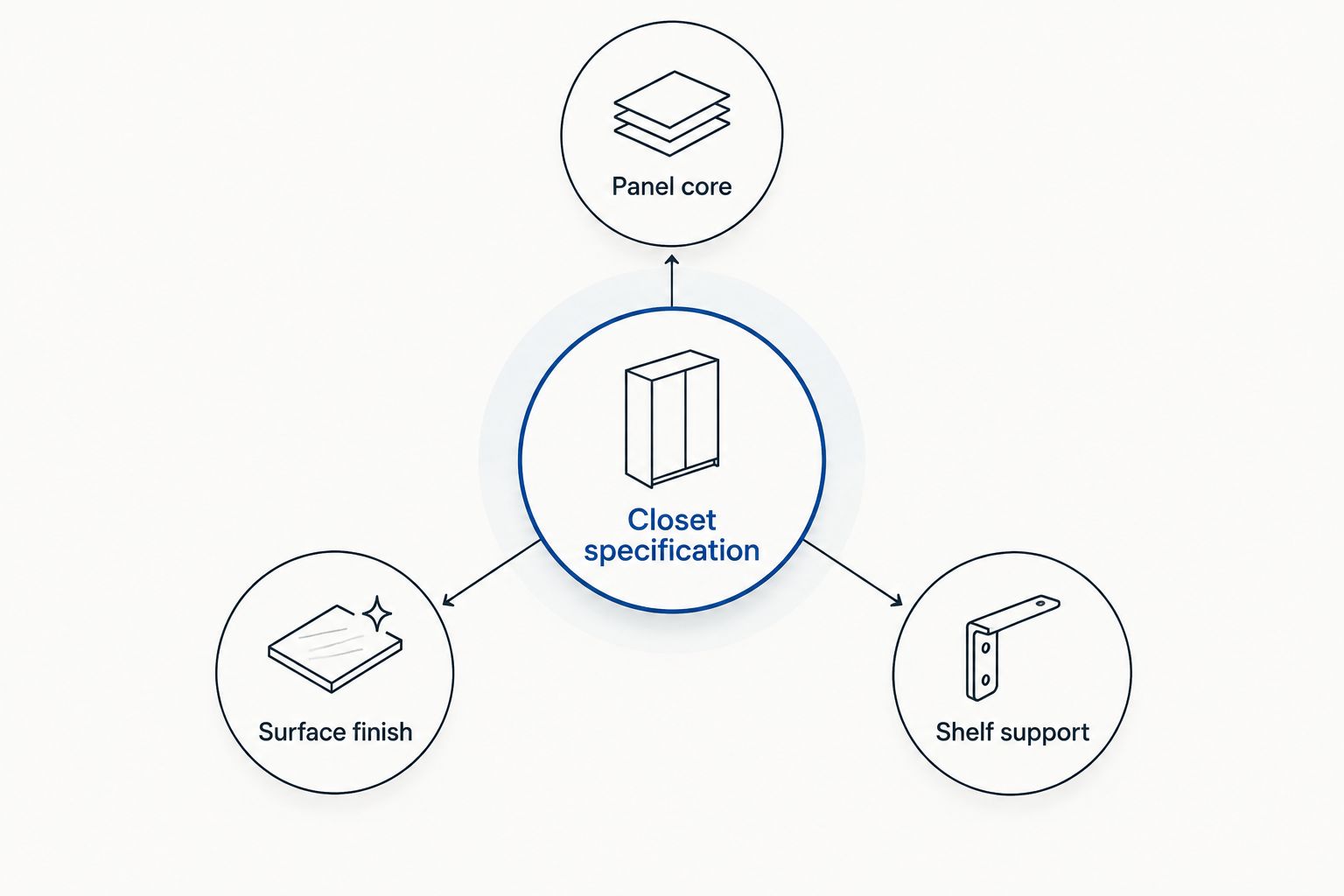
Use these 3 checks to turn a material preference into a buildable closet specification:
- Panel core: Identify the substrate for cabinet sides, shelves, doors, and drawer components separately.
- Surface finish: Confirm the laminate, veneer, or paint system and how exposed edges will be treated.
- Shelf support: Review unsupported spans, intermediate divisions, adjustable supports, and hanging-rail connections against your storage plan.
Separate your 2026 approvals into 2 stages: approve the physical material-and-finish sample, then approve the construction drawings. A finish sample cannot show whether a shelf has sufficient support; a drawing cannot fully communicate a wood finish's appearance.
Use the guide to reviewing a Los Angeles cabinet maker's shop drawings to organize questions about dimensions, components, and interfaces before fabrication.
For a North Hollywood homeowner, Polaris Home Design's custom closet consultation should begin with the complete storage brief. Bring your room measurements if available, photographs, clothing categories, and any planned changes to flooring or lighting; discuss who will verify final site conditions.
Plan your complete custom closet
Discuss materials, storage requirements, and an in-house design, build, and installation project.
Which closet materials should you choose?
Choose HPL over suitable plywood as the default starting point for a heavily used closet interior. Use veneered plywood where visible wood grain matters, solid hardwood for appropriate fronts and trim, and painted MDF where a smooth painted surface drives the design.
TFL over particleboard remains a practical interior option when its limitations are addressed through panel selection, edge protection, and supported spans. Do not reject or approve it without those details.
For your 2026 project, ask Polaris Home Design to connect each proposed closet material to a specific component and use. A mixed-material specification is often more purposeful than insisting that every part be made from the same board.
FAQ
What’s the best closet material for durability?
High-pressure laminate over suitable plywood is the default recommendation here for heavy-use closet interiors. Its performance still depends on panel quality, protected edges, shelf support, and sound hardware connections.
Is plywood better than MDF for closet shelves?
Plywood is generally the stronger starting point for loaded shelving when thickness and support conditions are comparable. MDF can serve appropriate shelf applications, but the design must address deflection rather than relying on the material name.
Are melamine closets durable enough for everyday use?
TFL panels, often called melamine panels, can suit everyday clothing storage when properly specified and supported. Check the substrate, edge banding, shelf spans, and hardware fixing details before approving them.
Is solid wood the most durable choice for an entire closet?
Solid wood is not automatically the best choice for every closet component. It offers repair potential for fronts and trim, but broad panels require construction that accommodates movement across the grain.
Which closet surface is easiest to refinish?
Solid hardwood generally offers more refinishing potential than thin wood veneer or decorative laminate. The existing finish, damage depth, and component construction determine what repair is practical.
What should I approve before custom closet fabrication?
Approve both a representative material-and-finish sample and construction drawings. Confirm panel cores, exposed edges, shelf supports, hardware connections, dimensions, and the intended storage arrangement.
Can I combine different materials in a custom closet?
Yes, different materials can serve different closet components. For example, durable laminate interiors can accompany wood-grain visible panels or painted fronts when the design resolves their junctions and finishes.
One last thing
The shelf holding your heaviest belongings deserves more scrutiny than an unloaded finish sample. Before signing off, identify that shelf on the drawings and ask how its span, panel, supports, and connections work together.
Approve a storage system, not just a surface. That is the most useful durability decision you can make before your closet is built.