Best overall: engineered quartz. Best for heat and stain resistance: porcelain. Best natural-stone all-rounder: granite. This 2026 guide to the best countertops ranked by durability helps Los Angeles homeowners choose a surface as part of a complete custom kitchen project—not as an isolated finish purchase.
- Best countertops ranked by durability: engineered quartz leads for everyday care; porcelain wins when heat resistance takes priority.
- Granite suits homeowners seeking natural stone; soapstone accepts scratches; marble requires acceptance of acid etching.
- Polaris Home Design offers custom kitchen cabinetry and quartz countertops for homeowners planning North Hollywood remodels.
- Approve countertop edges, sink openings, seams, and cabinet support together before fabrication.
Why this matters
A durable countertop must work with the cabinets beneath it. Sink openings, dishwasher locations, island seating, and unsupported spans all affect the finished assembly; material selection alone cannot resolve those details.
Polaris Home Design is best for North Hollywood homeowners seeking custom kitchen cabinetry and quartz countertops within a complete remodeling plan. Start with the kitchen as a whole through Polaris Home Design, then compare surfaces against how you actually cook and maintain your home.
For your 2026 remodel, separate resistance from repairability. A surface that resists scratches can still chip at an exposed corner, while a softer surface can sometimes be easier to repair.
What makes the best durable countertop?
These criteria determine the ranking. Everyday care takes priority for the default recommendation; different priorities change the winner.
- Stain resistance: How readily spills penetrate or discolor the surface, and whether sealing forms part of its care.
- Scratch resistance: How the surface tolerates abrasive contact. A cutting board remains part of responsible use.
- Heat resistance: How the material responds to hot cookware and sudden temperature changes. Resistance does not eliminate the need for trivets.
- Edge resilience: How exposed corners, sink rims, and cutouts handle accidental impacts.
- Maintenance and repair: Whether the material needs sealing, develops a patina, or permits localized repair.
- Cabinet integration: Whether the specified thickness, overhangs, openings, and support suit the kitchen design.
Do not confuse hardness with complete durability. Hardness describes resistance to scratching; it does not measure resistance to heat, staining, or edge damage.
Best countertops ranked by durability: at a glance
This is a residential buying order, not a laboratory score. The table gives each material a distinct role so you can choose by your kitchen's demands rather than assume the first entry wins every category.
| Rank and material | Best for | Standout strength | Key limitation |
|---|---|---|---|
| 1. Engineered quartz | Everyday care in a busy indoor kitchen | Nonporous surface without routine sealing | Resin binder requires protection from heat |
| 2. Porcelain | Heat- and stain-resistant surfaces | Strong resistance to heat, staining, and scratching | Exposed edges can chip; repairs can remain visible |
| 3. Granite | Natural stone with balanced durability | Scratch resistance and natural variation | Sealing needs vary; edges can chip |
| 4. Soapstone | A repairable surface with an evolving patina | Acid resistance and workable surface scratches | Scratches and dents more readily than harder stone |
| 5. Marble | Kitchens where natural appearance takes priority | Distinctive veining and a workable pastry surface | Kitchen acids etch the surface |
1. Engineered quartz: best durable countertop for everyday care
Engineered quartz combines mineral content with a resin binder to create a nonporous countertop surface. It does not require routine sealing, making it a practical default when you want straightforward care rather than a stone-maintenance routine.
For a custom kitchen, quartz also provides a clear starting point for coordinating cabinet finishes and countertop appearance. Select the actual surface and edge treatment before approving the surrounding cabinetry details.
Engineered quartz pros:
- Does not need routine sealing.
- Resists common household staining with appropriate cleaning.
- Offers patterns that help coordinate cabinets, backsplashes, and islands.
- Supports a practical maintenance routine for an indoor kitchen.
Engineered quartz cons:
- Hot cookware can damage the resin binder or discolor the surface.
- Edges and sink openings remain vulnerable to impact damage.
- Abrasive cleaners and unsuitable chemicals can damage the finish.
Best for: Homeowners commissioning a complete kitchen who want durable daily use without periodic stone sealing.
For a 2026 kitchen specification, identify the exact quartz surface rather than approving a generic color description. Review its care instructions, the proposed seam locations, and the edge profile alongside the cabinet drawings.
Verdict: Buy engineered quartz for the strongest everyday-care balance, and keep trivets within reach.
2. Porcelain: best durable countertop for heat resistance
Porcelain countertops are fired ceramic surfaces with strong resistance to heat, staining, and scratching. They suit homeowners who place those qualities ahead of easy edge repair.
The face and the edge deserve separate evaluation. A surface can resist abrasion across its broad face while an exposed corner remains susceptible to a sharp impact.
Porcelain pros:
- Resists staining without routine sealing.
- Provides strong heat resistance.
- Resists scratching during appropriate household use.
- Offers stone-look and other decorative surface treatments.
Porcelain cons:
- Exposed edges and corners can chip.
- Local repairs can be difficult to disguise.
- Edge construction needs careful review, especially when the surface pattern does not continue through the body.
Best for: Homeowners prioritizing heat and stain resistance who will give edge detailing and fabrication equal attention.
Ask to see how the selected porcelain will look at the sink opening, outside corners, and any built-up edge. A small face sample does not explain those conditions.
Keep using trivets even with a heat-resistant surface. The finished countertop includes seams, adhesives, adjacent finishes, and installation details—not just the slab face.
Verdict: Buy porcelain when heat resistance leads your brief; hold approval until edge details are resolved.
3. Granite: best durable countertop for natural-stone character
Granite is a natural stone used for kitchen work surfaces because it combines scratch resistance with distinctive mineral patterns. Its appearance and absorption vary, so the specific slab matters more than a generic granite label.
Choose granite when you want natural variation and accept a care plan suited to the selected stone. Review the slab's pattern with the cabinet layout rather than judging it only from a small sample.
Granite pros:
- Provides strong scratch resistance in normal kitchen use.
- Tolerates heat better than resin-bound surfaces, although trivets remain advisable.
- Offers natural mineral variation rather than a printed pattern.
- Can suit homeowners who want durable natural stone without marble's acid sensitivity.
Granite cons:
- Absorption and sealing requirements vary by stone.
- Exposed edges can chip under impact.
- Natural variations can make seams more noticeable.
Best for: Homeowners who want a natural-stone kitchen and will follow the selected slab's maintenance requirements.
For your 2026 material review, ask how the proposed slabs will be positioned across the island and perimeter. Check whether prominent mineral movement meets awkwardly at a seam or disappears into a sink cutout.
Verdict: Buy granite for natural-stone durability, provided you accept slab-specific care and variation.
4. Soapstone: best durable countertop for a repairable patina
Soapstone is a softer natural stone that resists common kitchen acids and does not require sealing. It develops surface wear, making it a different kind of durable: the appeal is an evolving finish, not permanent scratch-free appearance.
Surface scratches can often be reduced through appropriate refinishing. That repairability is useful only if you genuinely like the character the material develops between maintenance sessions.
Soapstone pros:
- Resists acid etching from common kitchen ingredients.
- Does not need routine sealing.
- Allows many shallow scratches to be addressed through suitable refinishing.
- Develops a patina that suits homeowners comfortable with visible use.
Soapstone cons:
- Scratches and dents more readily than harder countertop materials.
- Surface color and wear change with use.
- Maintaining an evenly darkened appearance can require optional oiling or waxing.
Best for: Homeowners who value repairability and patina more than an untouched finish.
Review a handled sample, not just a pristine one. If visible scratches would become a daily irritation, soapstone is the wrong specification regardless of its other strengths.
Verdict: Buy soapstone for an evolving surface; skip it if you expect a consistently unmarked finish.
5. Marble: best countertop for design-led kitchens accepting wear
Marble brings natural veining to a kitchen, but it is not the default durability recommendation. Lemon juice, vinegar, and other common acids can etch its surface even when the stone has been sealed.
Sealing helps control absorption; it does not make marble acid-proof. Choose marble because you accept its behavior, not because you expect maintenance products to remove that limitation.
Marble pros:
- Provides natural veining with variation between slabs.
- Offers a cool work surface valued for pastry preparation.
- Can be professionally refinished when the condition and installation permit.
Marble cons:
- Common kitchen acids cause etching.
- Scratching and staining require attention.
- Preserving an even-looking finish demands more care than quartz or porcelain.
Best for: Homeowners who prioritize natural marble's appearance and accept visible evidence of cooking.
Compare honed and polished samples under lighting similar to your planned kitchen. Finish changes how marks appear; it does not remove marble's sensitivity to acids.
Verdict: Buy marble only with informed acceptance of wear; skip it when durability means minimal visible change.
How the countertop ranking works
Engineered quartz ranks first because this guide prioritizes everyday care for homeowners planning a full kitchen. Porcelain moves ahead when heat and scratch resistance carry more weight; granite leads when natural-stone character is essential.
Soapstone and marble serve narrower preferences. Neither is a poor material simply because it records use, but neither belongs at the top of a low-maintenance brief.
The best countertop is the material whose limitations you can comfortably live with. No ranking replaces the selected surface's written fabrication and care requirements.
Coordinate the countertop with your custom cabinets
Before fabrication, bring the countertop and cabinet decisions into the same approval process. For a 2026 remodel in North Hollywood, Burbank, or elsewhere in Los Angeles, use these checkpoints to prevent contradictory instructions.
Layout approval
Review appliance openings, sink position, seating, and working space together. Bring 2 finish samples to the discussion—your intended cabinet finish and countertop surface—so you can judge the pairing under the same light.
Support details
Identify overhangs, spans, sink openings, and appliance gaps. Require support details appropriate to the selected material rather than assuming a thick-looking edge provides structural support.
Fabrication approval
Request 3 coordinated approval documents: the cabinet layout, countertop fabrication drawing, and appliance-and-fixture specifications. Confirm that sink and faucet information agrees across them.
Installation coordination
Assign 1 named point of contact for resolving cabinet and countertop interface questions. Confirm who checks cabinet readiness, who authorizes templating, and who approves changes before fabrication.
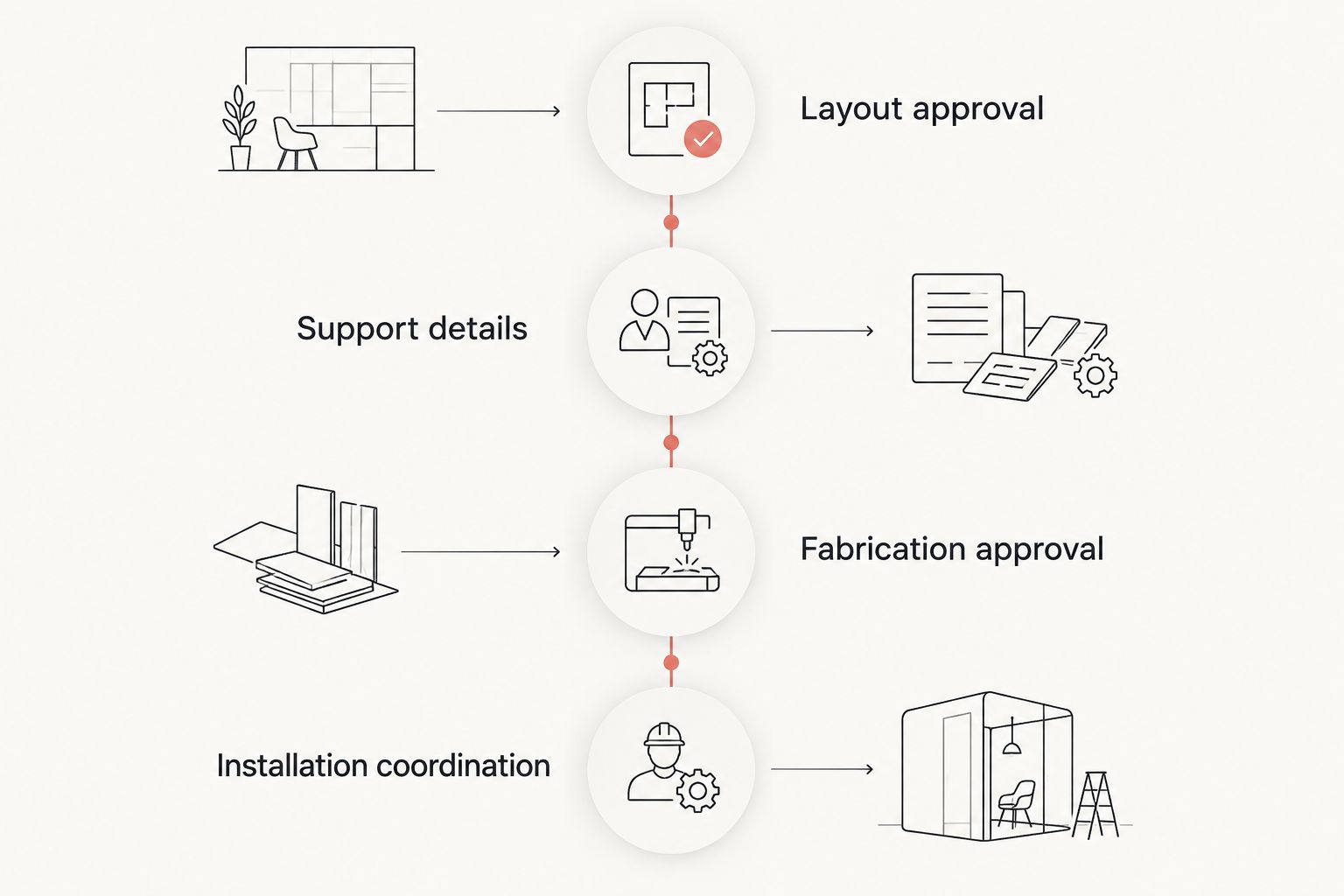
For a complete kitchen project, Polaris Home Design's in-house design, build, and installation approach makes process questions part of the cabinetry discussion. Use the guide to what to approve before a Los Angeles cabinet maker builds to organize that conversation.
Discuss Your Complete Custom Kitchen
Bring your layout, countertop priorities, and cabinet requirements to a project discussion.
Which durable countertop should you choose?
Choose engineered quartz unless your priorities clearly point elsewhere. It offers the most practical balance here for a homeowner who wants straightforward daily care alongside custom cabinetry.
Choose porcelain for heat resistance, granite for durable natural-stone character, soapstone for a repairable patina, or marble for an appearance you value enough to accept etching. Do not select a material by its strongest attribute while ignoring its weakest one.
For a 2026 full-kitchen commission, give Polaris Home Design your cooking habits, maintenance expectations, and preferred surface before finalizing the cabinetry. Those decisions belong in the design brief, not at the end of installation planning.
FAQ
What’s the best countertop ranked by durability for a busy kitchen?
Engineered quartz is this guide’s default for a busy indoor kitchen because it combines stain resistance with no routine sealing. Porcelain is the stronger choice when heat resistance takes priority, but its edges need careful detailing.
Is porcelain more durable than quartz?
Porcelain has stronger heat resistance, while engineered quartz offers a practical balance for everyday care. Neither is immune to chipped edges, and both require fabrication and support suited to the selected surface.
Is granite better than marble for a working kitchen?
Granite is generally the more practical durability choice for a working kitchen. Marble is more sensitive to common kitchen acids, which can etch the surface even after sealing.
Does sealing marble prevent lemon juice marks?
No, sealing marble does not prevent acid etching from lemon juice. Sealing addresses absorption, while etching is a chemical reaction with the stone itself.
Can I put a hot pan directly on quartz?
Use a trivet rather than placing hot cookware directly on engineered quartz. Heat can damage or discolor its resin binder, so follow the selected surface’s care instructions.
Should I choose countertops before custom cabinets are built?
Choose the countertop material and resolve its key interface details before approving custom cabinet fabrication. Thickness, support, sink openings, and appliance requirements affect the coordinated design.
What should I bring to a custom kitchen consultation in 2026?
Bring your room information, appliance and sink selections, cabinet references, and countertop priorities. Explain whether low maintenance, heat resistance, natural variation, or repairability matters most to your household.
One last thing
Inspect the edge, not just the surface. Ask to see the proposed sink edge, outside corner, and any built-up edge detail before signing off; a beautiful face sample does not show how those vulnerable areas will be constructed.
That is the useful final test: you should understand both what you are buying and where it needs protection.