Best overall: engineered quartz. Best for a slim profile: porcelain. Best for natural variation: granite. For your 2026 Los Angeles bathroom remodel, the best bathroom vanity countertop materials balance daily care, appearance, and fabrication requirements—not appearance alone.
- Engineered quartz leads the best bathroom vanity countertop materials for everyday use without routine sealing.
- Porcelain suits slim profiles; granite suits homeowners who want natural stone variation.
- Solid surface suits integrated basins; marble suits homeowners who accept etching and patina.
- Polaris Home Design suits Los Angeles homeowners commissioning custom bathroom vanities as part of a complete cabinetry project.
Why this matters
A countertop choice changes more than the visible surface. It affects sink mounting, faucet placement, edge construction, cabinet support, and the relationship between drawers and plumbing.
For homeowners commissioning a complete vanity in North Hollywood or elsewhere in Los Angeles, Polaris Home Design is best for custom bathroom vanity cabinetry planned as a complete project, not a countertop-only purchase. Start with custom bathroom vanity planning so the cabinet and countertop specifications develop together.
Choose the material before you approve the final cabinet drawings. Resolve its fabrication details before installation, rather than asking the installer to reconcile conflicting decisions on site.
What makes the best bathroom vanity countertop materials
Use these criteria for your 2026 material shortlist:
- Daily care: Separate surfaces that need periodic sealing from those that do not. Ask for the selected material's cleaning instructions.
- Chemical resistance: Distinguish staining from etching. A surface can resist stains yet still react to acidic products.
- Edge durability: Review exposed corners, sink openings, and thin edges—not just the middle of a sample.
- Fabrication fit: Confirm that the material supports your sink, faucet holes, backsplash, and intended edge treatment.
- Design control: Compare actual slabs or production samples with cabinet finishes under the bathroom's planned lighting.
- Repair expectations: Understand whether scratches, chips, or surface changes can be repaired locally and what remains visible afterward.
The strongest choice is the material whose limitations you accept before fabrication.
Materials at a glance for 2026
| Rank | Material | Best for | Standout feature | Key limitation |
|---|---|---|---|---|
| 1 | Engineered quartz | Everyday primary bathrooms | Nonporous surface without routine sealing | Heat and chemical precautions still apply |
| 2 | Porcelain | Slim, contemporary profiles | Low water absorption and strong stain resistance | Exposed edges require careful detailing |
| 3 | Granite | Natural variation in a busy bathroom | Distinctive mineral pattern and good wear resistance | Absorption and sealing needs vary by stone |
| 4 | Solid surface | Integrated basins and simpler junctions | Joined components can create a visually continuous assembly | Scratches more readily than harder mineral surfaces |
| 5 | Marble | Character-led bathrooms with accepted patina | Natural veining with depth and variation | Acids can etch the surface despite sealing |
These are material categories, not interchangeable specifications. The selected slab, finish, manufacturer instructions, and fabrication details still govern the finished vanity.
1. Engineered quartz: best for everyday primary bathrooms
Engineered quartz combines mineral content with resin binders to create a nonporous countertop surface. It does not require the routine sealing associated with some natural stones, making it a strong default for a bathroom used every day.
Quartz is not damage-proof. Hot styling tools need protection, and cleaning products must follow the selected manufacturer's instructions. Pale colors also deserve a sample review beside your sink and cabinet finish; similar-looking whites can have noticeably different undertones.
Engineered quartz pros:
- No routine stone sealing.
- Broad choice of colors and patterns.
- Suitable for coordinated vanity tops and backsplashes.
Engineered quartz cons:
- Direct heat can damage the resin-containing surface.
- Chips and repairs can remain visible, especially along edges.
Best for: Homeowners prioritizing straightforward daily care in a primary bathroom.
Polaris Home Design offers quartz countertops alongside custom bathroom vanities. Discuss the countertop and cabinetry together so sink placement, visible edges, and drawer clearances belong to the same design.
Verdict: Buy engineered quartz for the strongest everyday balance of care and design choice.
2. Porcelain: best for slim, contemporary vanity profiles
Porcelain slab countertops provide a hard, low-absorption surface with strong resistance to staining. They suit a bathroom where the design calls for a restrained edge and a crisp relationship between countertop, cabinetry, and wall finishes.
The edge deserves particular attention. A face pattern does not necessarily continue through the material, and a built-up edge introduces fabrication decisions that a small sample cannot explain.
Porcelain pros:
- Low water absorption.
- Strong resistance to common staining.
- Slim-profile design possibilities.
Porcelain cons:
- Corners and edges are vulnerable to impact damage.
- Through-body appearance varies by product; exposed edges need review.
Best for: Homeowners who want a thin-looking countertop and precise contemporary detailing.
Ask to see the proposed edge construction, sink cutout treatment, and any visible seams. A polished surface sample is not approval of the completed countertop assembly.
Verdict: Buy porcelain when slim detailing matters and the fabrication plan resolves its exposed edges.
3. Granite: best for natural variation in a busy bathroom
Granite is a natural stone with mineral variation that cannot be reduced to a repeatable printed pattern. It offers good resistance to ordinary wear, although its absorption and care requirements depend on the particular stone and finish.
Choose the actual slab rather than relying on a small showroom sample. A short vanity top can capture a very different section of the stone from the one that first attracted you.
Granite pros:
- Individual mineral pattern and color variation.
- Good resistance to everyday surface wear.
- Multiple finish and edge possibilities, subject to the stone.
Granite cons:
- Some selections require sealing and closer stain management.
- Slab variation makes sample-only approval unreliable.
Best for: Homeowners who want natural stone character without choosing marble's acid-sensitive surface.
Mark the intended sink opening on the slab layout. That opening removes material, so a distinctive feature placed in the wrong location can disappear during fabrication.
Verdict: Buy granite when you want natural variation and accept stone-specific maintenance.
4. Solid surface: best for integrated basins
Solid surface is an acrylic- or polyester-based material containing mineral fillers. Compatible countertop and basin components can be joined to create a visually continuous assembly with fewer distinct junctions to clean.
That continuity is the main reason to select it—not an expectation that it behaves like stone. The surface scratches more readily than harder mineral materials, although many scratches can be refinished by a qualified specialist.
Solid surface pros:
- Integrated basin possibilities.
- Joined surfaces can minimize visible seams.
- Many surface marks can be refinished.
Solid surface cons:
- Scratches are a practical consideration.
- Direct heat can damage the material.
Best for: Homeowners who prioritize an integrated basin and a quiet, continuous appearance.
Confirm the basin shape and overflow arrangement before approving the vanity. Those decisions affect cleaning, plumbing, and usable cabinet space, even when the countertop looks simple from above.
Verdict: Buy solid surface for integrated detailing; skip it if scratch resistance is your overriding priority.
5. Marble: best for bathrooms designed around natural patina
Marble offers natural veining and tonal depth, but its calcite content makes it vulnerable to acid etching. Sealing helps manage absorption; it does not make marble acid-proof.
A matte spot from an acidic product is different from a stain. If you expect the surface to remain visually unchanged, marble creates a mismatch between the design and your maintenance expectations.
Marble pros:
- Distinctive natural veining.
- A strong focal material for a restrained vanity design.
- Surface refinishing is possible through specialist stone work.
Marble cons:
- Acidic products can etch the surface.
- Stain management and sealing require attention.
Best for: Homeowners who value natural character and accept visible surface changes.
A honed finish changes how etching reads; it does not prevent the chemical reaction. Review both the finish and the care requirements before choosing a slab.
Verdict: Buy marble only if patina belongs in your expectations; otherwise, skip it for the primary vanity.
Specify thickness before the cabinet is built
Nominal stone slab thicknesses commonly include 2 cm and 3 cm. Porcelain countertop slabs also come in formats such as 12 mm, depending on the product. These examples are not universal requirements or a statement of any studio's current selections.
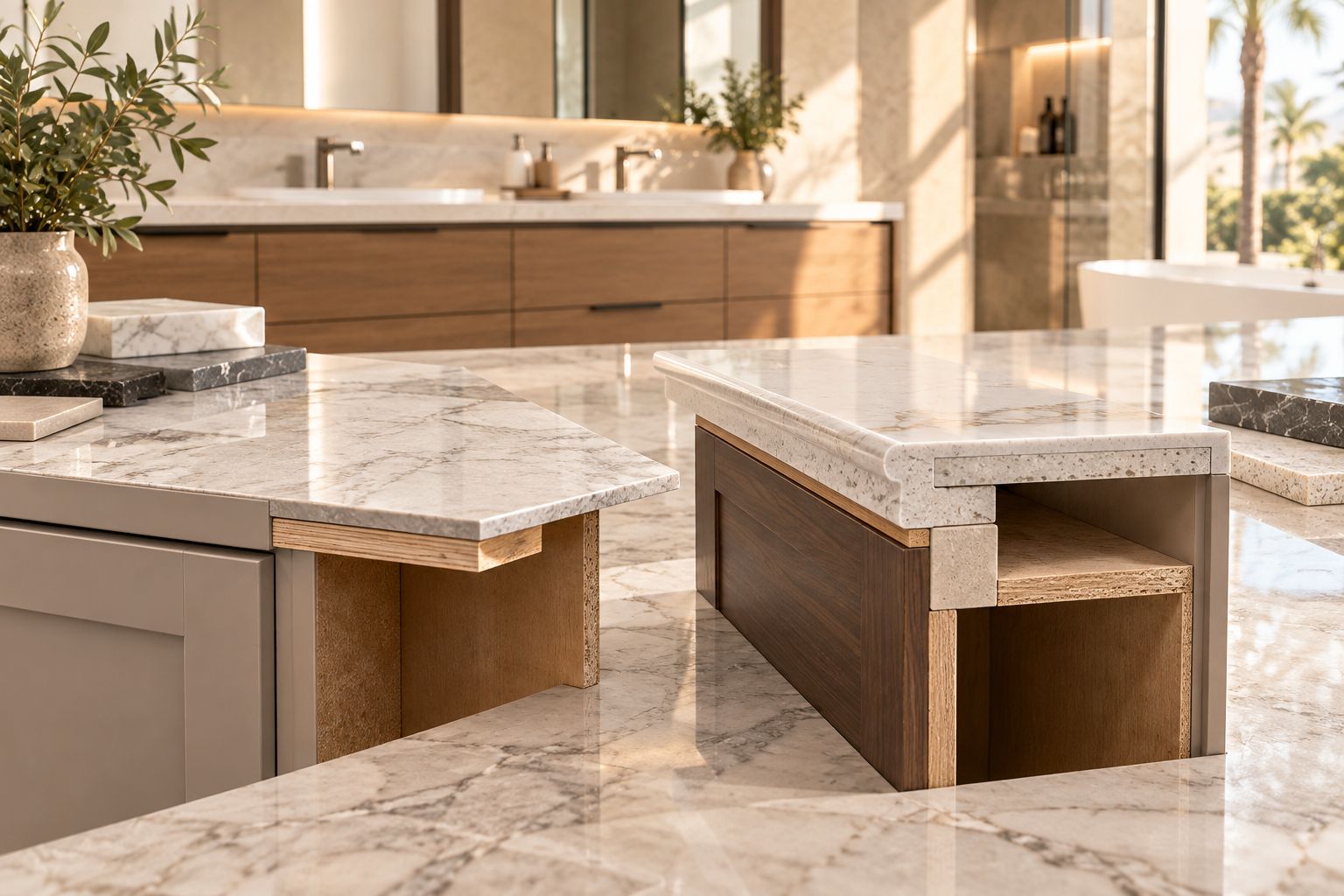
Thickness affects the visible edge, countertop weight, support strategy, and finished relationship to the sink. A thicker-looking edge can also be fabricated from thinner material, so appearance alone does not reveal the assembly.
Ask for the actual material thickness and a section drawing of any built-up edge. Confirm what sits beneath the surface, how the sink is supported, and where seams remain visible.
Turn the material choice into a complete vanity specification
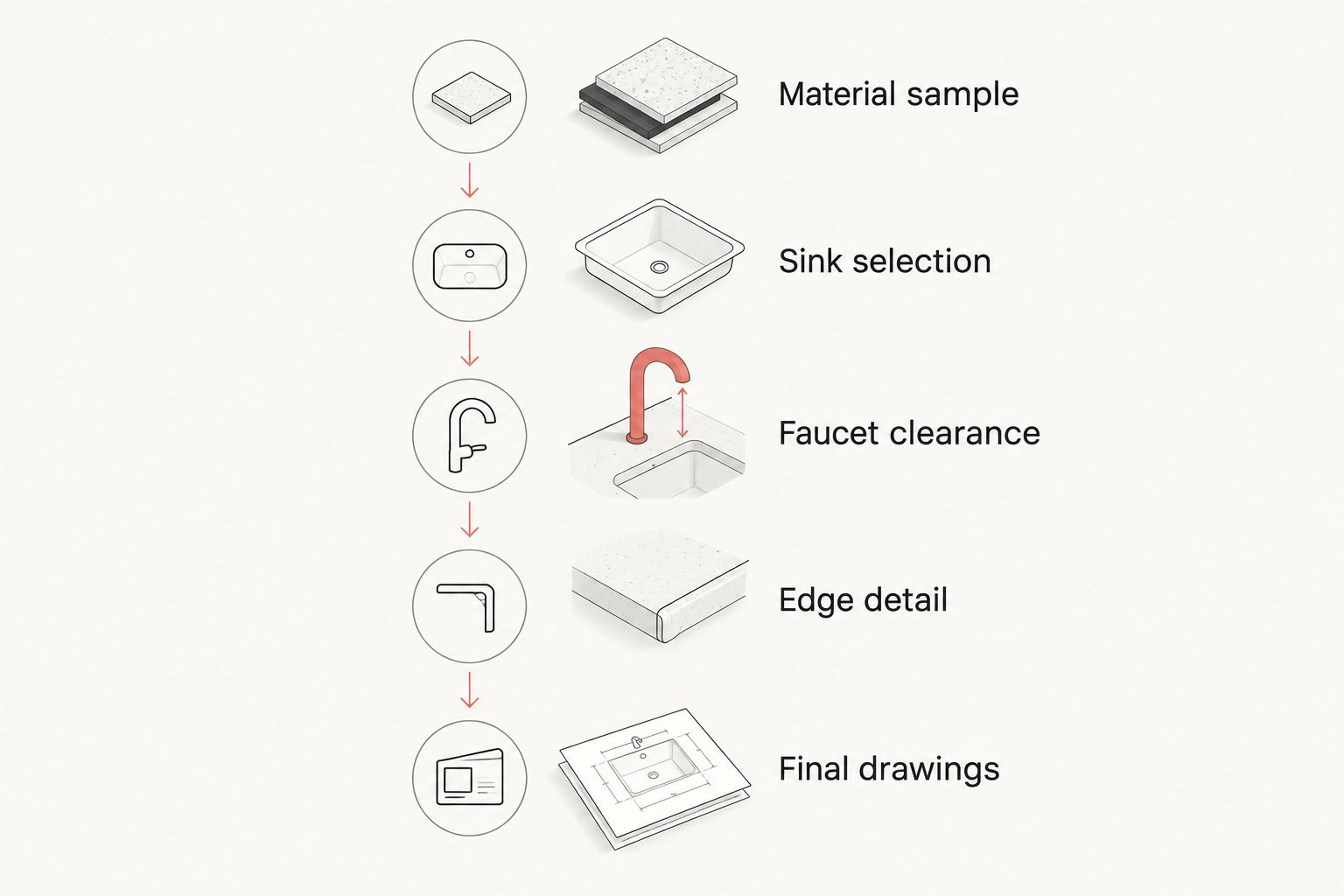
A successful custom vanity needs agreement between the countertop, cabinet, fixtures, and room. Use this approval sequence before authorizing fabrication.
Material sample
Review the actual slab or a representative production sample beside the cabinet finish. Compare it with the floor and wall materials under the intended lighting, not just showroom lighting.
Sink selection
Approve the sink model, mounting method, and cutout requirements. Check that the basin and drain leave room for the storage you expect beneath them.
Faucet clearance
Coordinate the faucet with the basin, backsplash, and mirror. Check handle movement and cleaning access; a faucet that fits its holes can still be awkward to use.
Edge detail
Specify the edge profile, exposed corners, backsplash junction, and seam locations. Request a section where the drawing leaves the construction unclear.
Final drawings
Confirm that the material decisions appear in the approved cabinet and countertop documents. Use the guide to reviewing a cabinet maker's shop drawings to organize those approvals.
Polaris Home Design's in-house design, build, and installation approach supports a complete cabinetry discussion. Bring your bathroom plans, fixture selections, storage priorities, and material preferences so the consultation addresses the whole vanity rather than a detached surface choice.
Discuss your complete custom vanity
Bring your bathroom plans, fixture selections, and material preferences to a full-project conversation.
How we ranked the materials in 2026
This ranking prioritizes daily care, chemical resistance, edge durability, fabrication fit, and repair expectations for homeowners commissioning complete bathroom vanities. It is a specification guide, not a claim of laboratory testing.
Quartz leads because it removes routine sealing from the care plan without requiring acceptance of marble's acid sensitivity. The remaining materials earn distinct places: slim profiles, natural variation, integrated basins, or intentional patina.
Which material should you choose in 2026?
Choose engineered quartz unless another material solves a specific design requirement you value more. Choose porcelain for a slim architectural profile, granite for natural variation, solid surface for an integrated basin, or marble for character that includes surface change.
For a North Hollywood homeowner planning a complete bathroom vanity with Polaris Home Design, the next move is a coordinated project brief. Settle the storage needs, sink, faucet, edge, and maintenance expectations before approving fabrication.
FAQ
What’s the best bathroom vanity countertop material for everyday use?
Engineered quartz is the strongest default for everyday bathroom use because it is nonporous and does not require routine sealing. Protect it from direct heat and follow the selected manufacturer’s cleaning instructions.
Is quartz better than marble for a bathroom vanity?
Quartz is better when straightforward maintenance is the priority. Marble suits homeowners who accept acid etching and patina as part of natural stone ownership.
Does a granite bathroom countertop need sealing?
Granite’s sealing requirements depend on the particular stone and finish. Obtain care instructions for the selected slab rather than assuming all granite behaves alike.
Can porcelain work with an undermount bathroom sink?
Porcelain can work with an undermount sink when the selected product and fabrication system permit it. Approve the cutout, exposed edge, and sink support before fabrication.
What’s the best material for an integrated vanity sink?
Solid surface is a strong choice for an integrated vanity basin because compatible components can be joined into a visually continuous assembly. Review scratch and heat precautions before committing.
Will sealing stop marble from etching?
No, sealing does not stop marble from etching. Sealers address absorption, while acids react with the stone itself.
Should I choose the countertop before ordering custom vanity cabinets?
Choose the countertop material before approving final vanity construction drawings. Its thickness, sink opening, support needs, and edge details affect the cabinetry specification.
One last thing
The sink opening removes part of the surface you selected. Before approving a strongly veined slab, ask to see the proposed cutout positioned on the layout. Approve the material that will remain visible—not just the slab before cutting. That small planning decision connects the countertop's appearance to the finished vanity.