Best overall: recessed linear LED lighting. Best for hanging clothes: vertical LED channels. Best for shelves: under-shelf LEDs. For homeowners commissioning a Los Angeles custom closet in 2026, the strongest plan combines targeted cabinet lighting with separate room lighting, rather than asking one ceiling fixture to do everything.
- The best closet lighting options combine recessed linear LEDs, targeted shelf lighting, and separate room illumination.
- Vertical LED channels suit hanging sections; under-shelf LEDs suit folded clothes and accessories.
- Polaris Home Design suits homeowners commissioning complete custom closets, rather than purchasing lighting components alone.
- Approve fixture locations, wiring routes, controls, and service access before cabinetry fabrication.
Why this matters
A bright closet is not necessarily a usable closet. Shelves, hanging clothes, doors, and your own body interrupt light; adding a brighter ceiling fixture does not resolve every shadow.
For your 2026 project, treat lighting as part of the cabinetry design. The custom closet planning guide provides the broader starting point: establish what you store, where you stand, and how each compartment opens before selecting fixtures.
Polaris Home Design is best for homeowners commissioning complete custom closets, not standalone lighting purchases. Bring the lighting brief into the same discussion as hanging space, drawers, doors, and finishes so the project reads as one considered design.
What makes the best closet lighting options?
Use these criteria to assess a lighting proposal before approving the cabinetry:
- Useful coverage: Light reaches garment fronts, shelf contents, and the floor where you stand—not just the ceiling.
- Glare control: Channels and diffusers conceal bright emitters from normal standing and seated viewpoints.
- Color consistency: Fixtures use a coordinated color temperature, with color rendering suitable for comparing clothing.
- Cabinet integration: Channels, wiring, hinges, adjustable shelves, and hanging rods work together without collisions.
- Service access: Drivers, connections, and replaceable components remain accessible after installation.
- Safe specification: The electrician verifies fixture suitability, electrical requirements, and applicable closet-storage clearances.
For a 2026 specification, compare samples at 2700 K, 3000 K, and 4000 K rather than choosing from photographs. These are color-temperature examples, not brightness levels: the lower values appear warmer, while the higher value appears cooler. Compare them beside your actual cabinet finish and clothing.
Ask for a color rendering index of 90 or higher as a selection target. CRI describes color rendering, not light output; it does not replace a physical sample review.
Closet lighting options at a glance
| Rank and option | Best for | Standout feature | Key limitation |
|---|---|---|---|
| 1. Recessed linear LEDs | A coordinated custom closet lighting plan | Continuous light integrated into cabinet details | Requires early channel and wiring decisions |
| 2. Vertical LED channels | Hanging sections | Light distributed along garment height | Poor placement creates direct glare |
| 3. Under-shelf LEDs | Folded clothes and accessories | Light directly beneath an obstructing shelf | Shelf adjustment complicates wiring |
| 4. Ceiling-mounted lighting | Walk-in circulation | General illumination independent of compartments | Does not resolve cabinet shadows alone |
| 5. Drawer-integrated lighting | Deep accessory drawers | Light inside the open drawer | Adds moving-part and service coordination |
These options describe different applications, not mutually exclusive systems. A vertical channel can also be recessed linear lighting; its separate ranking reflects the particular storage problem it solves.
1. Recessed linear LEDs: best for integrated closet lighting
Recessed linear LEDs place a continuous light source inside a planned cabinet channel, typically behind a diffuser. The channel becomes part of the cabinetry detail rather than an attachment selected after installation.
This is the default starting point for a full custom project because the designer can coordinate the light with partitions, shelves, and trim. Recessing alone does not guarantee comfort: the channel must also sit outside your direct sightline.
Recessed linear LED pros:
- Integrates lighting into the cabinet design.
- Supports continuous illumination across selected storage areas.
- Allows the diffuser and channel position to be reviewed together.
Recessed linear LED cons:
- Requires channel dimensions and wiring routes before fabrication.
- Concealed components still need a practical replacement route.
Best for: Homeowners planning cabinetry and lighting together, with an emphasis on controlled detailing.
For your 2026 drawings, ask to see a section through the channel, not just a line on an elevation. The detail should show what you see when standing at the closet opening and how the light source is removed for service.
Verdict: Buy as the primary integrated approach, with placement approved before fabrication.
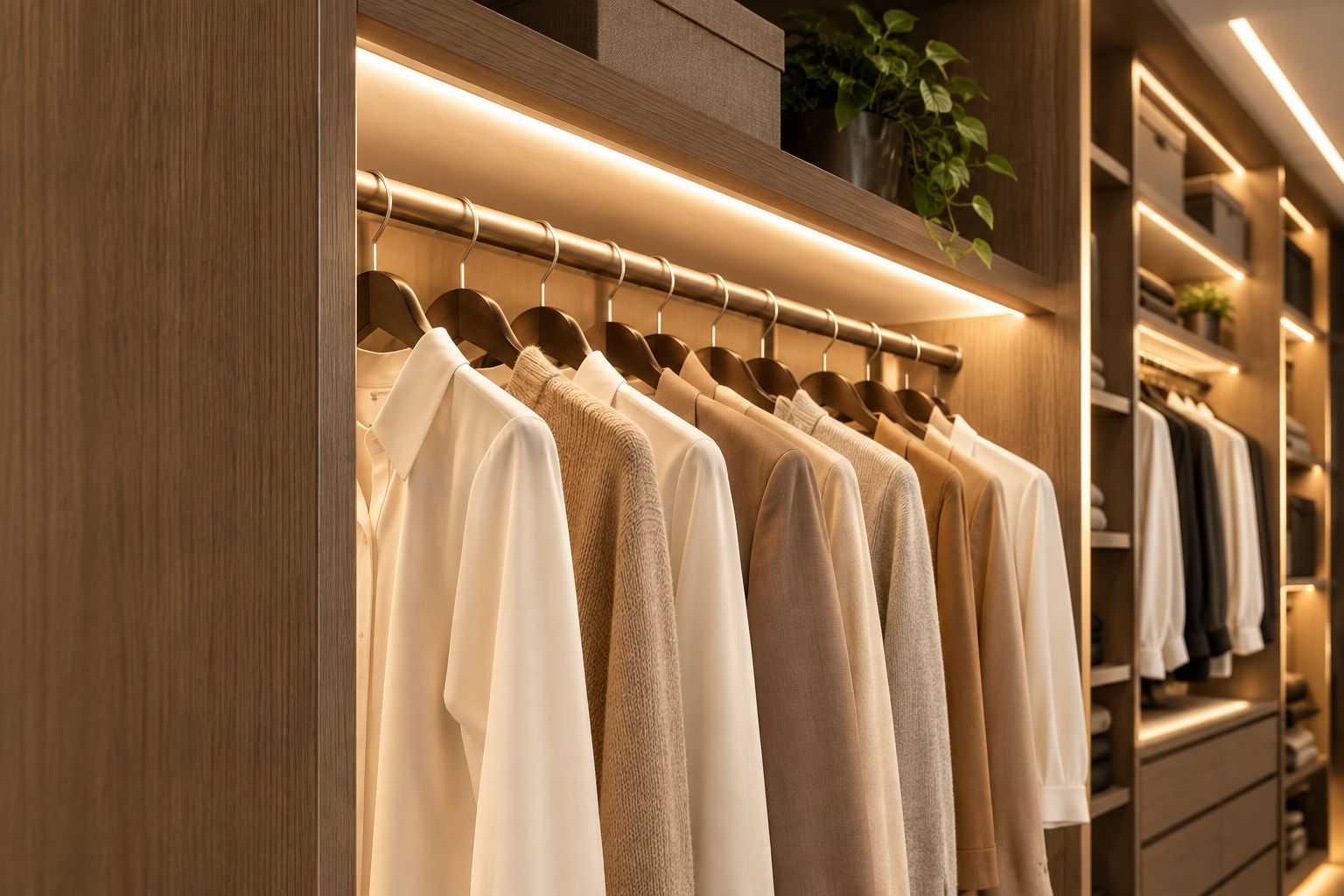
2. Vertical LED channels: best for hanging clothes
Vertical LED channels distribute light along the height of a hanging compartment. They address the limitation of light placed only above clothing, where upper garments and shelves obstruct the path downward.
Position matters more than symmetry. A channel that looks balanced on a drawing can shine directly into your eyes when you open the door, especially if it sits on an exposed front-facing surface.
Vertical LED channel pros:
- Brings light alongside hanging garments.
- Serves tall compartments without relying only on overhead light.
- Can be coordinated with cabinet partitions and door openings.
Vertical LED channel cons:
- Exposed emitters create uncomfortable sightlines.
- Clothes can obstruct channels positioned too far behind the hanging line.
Best for: Long-hang and double-hang compartments where garment fronts remain difficult to see.
Review the proposed channel with clothing in place, not an empty cabinet. Check the hanging rod, garment depth, door swing, and viewing angle together; an unobstructed light path on paper is not enough.
Verdict: Buy for hanging sections that need light along the garment height.
3. Under-shelf LEDs: best for folded clothes and accessories
Under-shelf LEDs illuminate the compartment immediately below a shelf. They are useful where stacked shelving blocks light from reaching folded clothing, handbags, or other stored items.
A forward position can help light reach the visible face of stored items, but the exact location needs a glare check. A decorative glow at the back of a shelf is not the same as useful light across its contents.
Under-shelf LED pros:
- Targets individual storage compartments.
- Places light below the shelf creating the shadow.
- Separates shelf visibility from general room illumination.
Under-shelf LED cons:
- Adjustable shelves require a coordinated connection strategy.
- Tall stacks or oversized objects still obstruct light.
Best for: Shelving dedicated to folded clothing, bags, and accessories.
Decide which shelves must remain adjustable before approving the lighting detail. If moving a shelf requires disturbing concealed wiring, the storage is not meaningfully flexible. Ask the designer to demonstrate how adjustment and disconnection work.
Verdict: Buy for selected shelving, rather than illuminating every shelf automatically.
4. Ceiling-mounted lighting: best for walk-in circulation
Ceiling-mounted lighting provides general illumination for entering, moving through, and using a walk-in closet. It serves the room around the cabinetry rather than replacing light inside each compartment.
Recessed fixtures, surface-mounted fixtures, and decorative fixtures require different ceiling and sightline decisions. Choose the format around the room layout, then check coverage at open doors and standing positions.
Ceiling-mounted lighting pros:
- Lights circulation areas independently of cabinet doors.
- Supports general visibility throughout the room.
- Can operate separately from detailed cabinet lighting.
Ceiling-mounted lighting cons:
- Shelves and clothing still cast shadows inside compartments.
- A fixture behind you can leave your body between the light and storage.
Best for: Walk-in closets needing a clear general-lighting layer.
For a 2026 walk-in plan, review ceiling lighting against the furnished layout, not an empty floor plan. Include islands, benches, open doors, and the positions where you select clothing. Decorative presence does not establish useful coverage.
Verdict: Buy for circulation; skip it as the sole lighting source for deep cabinetry.
5. Drawer-integrated lighting: best for deep accessory drawers
Drawer-integrated lighting illuminates contents when a drawer opens. It is a targeted addition for compartments where depth, internal dividers, or the countertop above limit visibility.
Use it selectively. A shallow drawer with clear room illumination does not automatically benefit from another electrical component, while a deep compartment deserves a closer review.
Drawer-integrated lighting pros:
- Directs light into the open storage compartment.
- Helps reveal contents around internal dividers.
- Can illuminate a drawer independently of adjacent shelving.
Drawer-integrated lighting cons:
- Requires coordination with drawer movement and hardware.
- Connections and activation components need service access.
Best for: Deep accessory drawers whose contents remain shadowed when open.
Ask how the light activates, how the drawer is removed, and what happens to the connection during servicing. Review the full opening motion before approving the detail; a light that obstructs hardware is not a finished solution.
Verdict: Buy for demonstrated visibility problems; skip it as a default addition to every drawer.
How the options are ranked
The ranking prioritizes useful coverage, glare control, color consistency, cabinet integration, service access, and safe specification. Recessed linear LEDs lead because they provide a flexible foundation for planned cabinet lighting; the remaining options address specific storage or room-level needs.
This is a specification guide, not a comparison of tested fixture brands. Final selection depends on the actual closet layout and the proposed fixture documentation.
Approve the lighting before the cabinetry is built
Your 2026 lighting approval should resolve the installation details, not simply identify a preferred appearance. For a North Hollywood homeowner commissioning a complete closet, these decisions belong in the cabinet drawings and electrical coordination.
- Storage layout: Identify hanging sections, fixed shelves, adjustable shelves, drawers, and door movements.
- Light placement: Show channels and fixtures in elevations and sections, including the direction of illumination.
- Controls: Decide which lights operate together, which use door activation, and where manual controls belong.
- Service access: Identify accessible driver locations and component-removal routes.
- Electrical coordination: Have the electrician confirm fixture suitability, supply requirements, and applicable installation clearances.
Assign responsibility for cabinet channels, electrical connections, controls, and final checks explicitly. An in-house cabinetry process still needs a clear electrical scope; do not assume every task belongs to the same trade.
At Polaris Home Design, make the lighting brief part of the complete custom closet discussion. Bring your storage requirements, finish references, and control preferences so the cabinetry proposal can address them together.
Discuss your complete custom closet
Bring your storage layout, finish references, and lighting priorities into one project discussion.
Which closet lighting should you choose?
Choose recessed linear LEDs as the default integrated approach, then add light only where the storage requires it. Use vertical channels for hanging clothes, under-shelf LEDs for obstructed shelving, and ceiling lighting for walk-in circulation. Reserve drawer lighting for compartments with a clear visibility problem.
Polaris Home Design custom closets should be discussed as complete cabinetry projects, with lighting considered alongside dimensions, materials, and installation. The objective is useful illumination within a considered design—not the largest possible collection of fixtures.
FAQ
What are the best closet lighting options for a custom closet?
Recessed linear LEDs are the best default for an integrated custom closet lighting plan. Add vertical channels for hanging sections, under-shelf LEDs for shelving, and separate ceiling lighting for walk-in circulation.
Are LED strips better than ceiling lights in a closet?
Integrated LED strips are better for targeted cabinet illumination, while ceiling lights serve general room visibility. A walk-in closet often needs both functions because shelves and clothing interrupt overhead light.
Should closet lighting be warm white or cool white?
Choose closet color temperature by comparing actual samples beside your clothing and cabinet finish. Review 2700 K, 3000 K, and 4000 K examples, and keep the selected fixtures consistent unless the design deliberately separates lighting zones.
What CRI should I request for closet lighting?
Request a CRI of 90 or higher as a selection target when comparing clothing colors. Review a physical sample as well, because CRI alone does not describe brightness, glare, or every aspect of color appearance.
Can adjustable closet shelves have integrated lighting?
Adjustable shelves can have integrated lighting when the connection system accommodates movement. Ask how each shelf disconnects, relocates, and reconnects before approving the cabinet detail.
Are motion sensors or door switches better for closet lights?
Door switches suit enclosed compartments, while occupancy sensors suit room-level activation. Specify manual control and activation behavior so the lights remain useful while you stand still or leave a door open.
When should I plan lighting for a Los Angeles custom closet?
Plan lighting before cabinet drawings receive fabrication approval. Channel dimensions, wiring routes, controls, driver access, and electrical responsibilities affect the finished cabinetry.
One last thing
Ask to review the lighting from your normal standing position with a door open and clothing in place. An empty, fully illuminated cabinet conceals the very shadows you need the design to solve.
For a Polaris Home Design custom closet consultation, bring this single requirement: show how the light reaches the stored items, and show how the lighting can be serviced. Appearance and access belong in the same approval.