Best overall: deep-drawer dividers. Best for daily cleanup: waste-and-recycling pullouts. Best for baking sheets: vertical tray dividers. For homeowners commissioning a complete kitchen in 2026, Polaris Home Design is best suited to planning cabinet storage as part of a custom cabinetry project, rather than choosing accessories separately.
- Deep-drawer dividers lead the best kitchen cabinet storage accessories for keeping everyday cookware organized.
- Waste-and-recycling pullouts belong near food preparation, with clearance checked against adjacent appliances.
- Choose corner mechanisms only after comparing them with a simpler cabinet layout.
- Polaris Home Design suits Los Angeles homeowners planning storage within a complete custom kitchen cabinetry project.
Why this matters
A cabinet accessory changes more than the interior. Its mechanism, mounting requirements, and opening clearances affect the cabinet around it. Choose those details before approving construction, not after the doors arrive.
For your 2026 North Hollywood kitchen remodel, start with what you store and where you use it. The same planning applies to homeowners in Burbank, Glendale, and elsewhere in Los Angeles: the right accessory solves a specific daily task without obstructing another.
What makes the best kitchen cabinet storage accessories
Judge each option against these criteria before choosing finishes or fittings:
- Task fit: Store cookware, food, and cleanup supplies where you use them.
- Usable space: Compare the storage left after runners, frames, and dividers are installed.
- Access: Check whether you can reach the contents without removing unrelated items.
- Clearance: Account for cabinet doors, handles, appliances, plumbing, and neighboring drawers.
- Maintenance: Favor accessible surfaces and removable components where spills accumulate.
- Specification: Confirm the exact mechanism, mounting needs, and stated load rating before fabrication.
An accessory earns its place by improving a task. Adding mechanisms everywhere is not a storage strategy.
Kitchen cabinet storage accessories at a glance
| Rank and accessory | Best for | Standout feature | Key limitation |
|---|---|---|---|
| 1. Deep-drawer dividers | Everyday cookware | Separates cookware within a visible drawer | Dividers consume space and need sizing |
| 2. Waste-and-recycling pullouts | Daily cleanup | Keeps bins within the cabinetry | Needs removal clearance and cleaning access |
| 3. Vertical tray dividers | Baking sheets and boards | Stores flat items upright | Fixed spacing restricts thicker items |
| 4. Rollout shelves | Existing shelf-style storage habits | Brings contents forward | Door clearance and runner space matter |
| 5. Spice drawer inserts | Frequent cooking | Presents labeled containers from above | Must match container sizes and drawer depth |
| 6. Corner pullout mechanisms | Unavoidable blind corners | Moves concealed storage toward the opening | Mechanisms occupy interior space |
| 7. Tall pantry pullouts | Narrow pantry zones | Moves food storage out of a tall cabinet | Loaded movement and frame space need review |
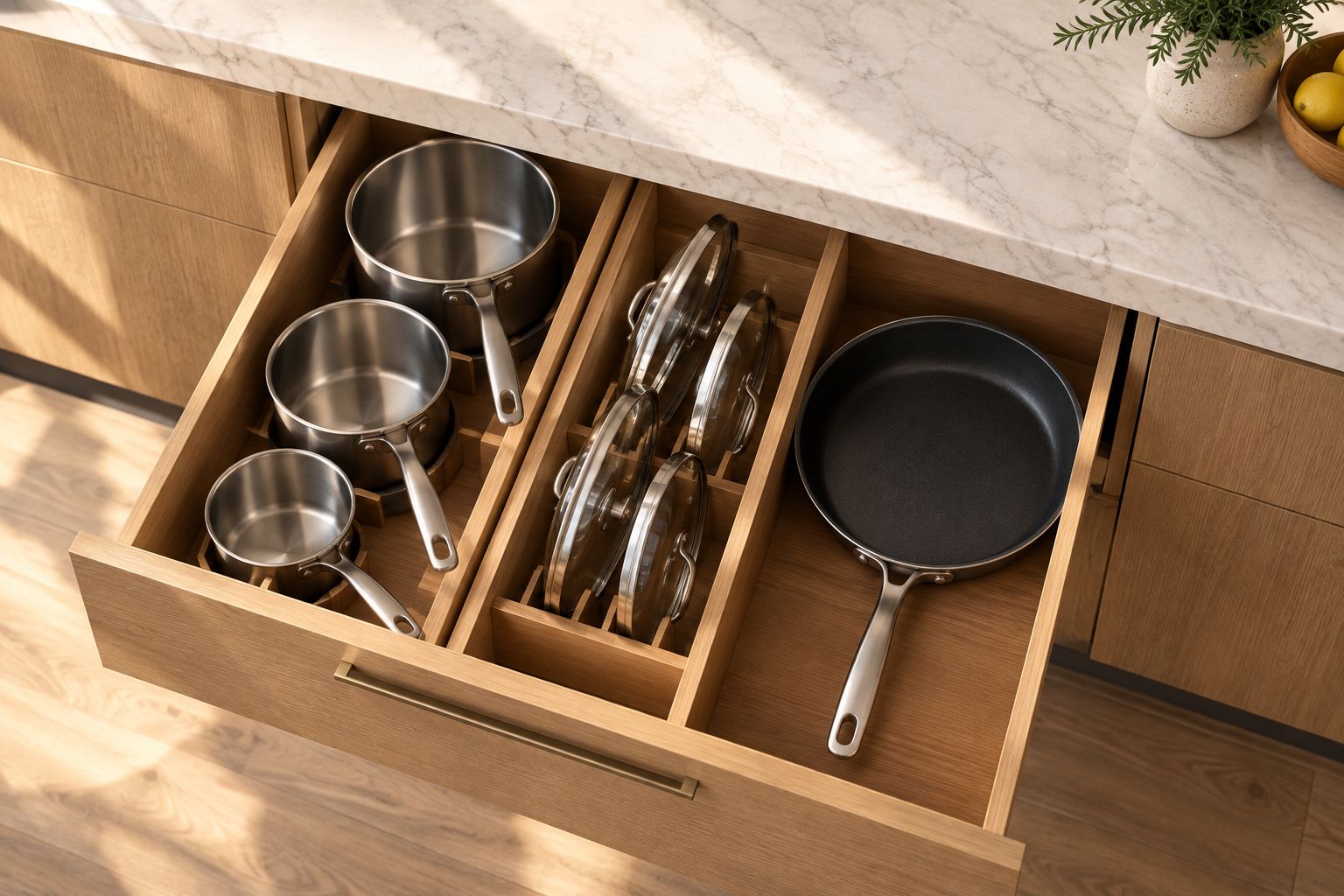
1. Deep-drawer dividers: best for everyday cookware
Deep-drawer dividers separate pots, lids, and cookware inside a base drawer. Instead of building a tall stack, you assign each category a position. The drawer and divider layout should follow your actual cookware, especially wide handles and oversized lids.
Deep-drawer divider pros:
- Keep cookware categories separated.
- Make stored items visible from above.
- Allow dedicated positions for lids and smaller pieces.
Deep-drawer divider cons:
- Partitions reduce uninterrupted drawer space.
- Fixed layouts restrict changes to your cookware collection.
Best for: Homeowners who cook regularly and want daily cookware near the cooking zone.
Ask the designer to draw your largest pan within the proposed drawer interior. An attractive grid is irrelevant if its compartments do not fit what you own. Verdict: Buy for daily cookware when the layout matches your inventory.
2. Waste-and-recycling pullouts: best for daily cleanup
A waste-and-recycling pullout places removable bins inside a cabinet. Position it around your preparation and cleanup routine, then check its relationship to the sink and dishwasher. A concealed bin is not convenient if an open dishwasher blocks it.
Waste-and-recycling pullout pros:
- Keeps bins out of the open floor area.
- Groups waste sorting in one cabinet.
- Places disposal near the work surface.
Waste-and-recycling pullout cons:
- Uses cabinet space otherwise available for storage.
- Requires access for cleaning bins and surrounding surfaces.
Best for: Households that prepare meals regularly and want a defined cleanup station.
Review the pullout with neighboring doors open. Confirm that you can lift out the containers without an obstruction above them. Verdict: Buy when the position supports preparation and cleanup.
3. Vertical tray dividers: best for baking sheets and boards
Vertical tray dividers keep baking sheets, cooling racks, and cutting boards upright. Each item slides into a separate slot rather than sitting beneath a stack. Base cabinets and upper compartments require different reach considerations, so choose the location before setting the spacing.
Vertical tray divider pros:
- Separates flat kitchen equipment.
- Reduces the need to dismantle stacks.
- Makes categories easy to identify.
Vertical tray divider cons:
- Narrow fixed slots exclude thicker boards or roasting pans.
- High locations make heavy items harder to retrieve.
Best for: Homeowners who bake or use several cutting boards.
Group your equipment by thickness before approving the divisions. Leave an appropriate position for the thickest item, rather than repeating identical slots throughout. Verdict: Buy for a defined collection of flat equipment.
4. Rollout shelves: best for shelf-style storage habits
Rollout shelves bring the contents of a base cabinet toward you. They suit homeowners who prefer broad storage surfaces but dislike reaching behind the front row. In a complete remodel, compare them with drawers before committing to doors with internal rollouts.
Rollout shelf pros:
- Brings rear items into view.
- Supports mixed storage without fixed compartments.
- Preserves a shelf-style interior arrangement.
Rollout shelf cons:
- Cabinet doors must clear the moving shelf.
- Runners and side clearances reduce usable width.
Best for: Homeowners who want pull-forward access behind cabinet doors.
For your 2026 cabinet plan, ask why this location needs a door plus an internal shelf rather than a drawer front. The answer should reflect the contents or design, not habit. Verdict: Hold until compared with a drawer-based alternative.
5. Spice drawer inserts: best for frequent cooking
Spice drawer inserts arrange containers so their labels are visible from above. They work best when placed within the preparation or cooking area without creating an awkward reach. Confirm container height, lid shape, and drawer clearance before selecting the insert.
Spice drawer insert pros:
- Presents labels in an ordered arrangement.
- Separates small containers from larger pantry goods.
- Assigns frequently used ingredients a dedicated location.
Spice drawer insert cons:
- Mixed container shapes complicate a uniform layout.
- A dedicated spice drawer displaces other nearby storage.
Best for: Homeowners with a frequently used, identifiable spice collection.
Bring the containers you intend to keep, not just a count of jars. A layout that requires replacing every container introduces another household task. Verdict: Buy when your collection fits without forced decanting.
6. Corner pullout mechanisms: best for unavoidable blind corners
Corner pullout mechanisms move trays or baskets from a concealed corner toward the cabinet opening. Their usefulness depends on the cabinet geometry and surrounding clearances. Compare the retrieved storage with the space occupied by the mechanism itself.
Corner pullout mechanism pros:
- Brings concealed contents closer to the opening.
- Gives a blind corner a defined storage purpose.
- Reduces reaching into the cabinet recess.
Corner pullout mechanism cons:
- Moving components occupy interior space.
- Tray shapes restrict which objects fit.
Best for: Kitchens whose approved layout retains a blind corner.
Ask to see the proposed mechanism in both its closed and extended positions. Do not assume that filling a corner produces the most useful kitchen arrangement. Verdict: Hold until the cabinet layout justifies the mechanism.
7. Tall pantry pullouts: best for narrow pantry zones
A tall pantry pullout moves its storage frame out of the cabinet. It gives narrow pantry storage a defined access path, but the frame and runners occupy space. Review how you will load it, reach its upper shelves, and operate it when filled.
Tall pantry pullout pros:
- Moves stored food toward the cabinet opening.
- Keeps a narrow pantry zone organized.
- Provides distinct shelf positions for food categories.
Tall pantry pullout cons:
- The frame reduces clear interior storage dimensions.
- Contents move together whenever you open the unit.
Best for: Homeowners whose layout includes a narrow, dedicated pantry cabinet.
Check the specified load rating against the intended contents, including heavy containers. Compare the proposal with individually accessible pantry shelves or drawers. Verdict: Hold until access and loading requirements are confirmed.
Turn accessory choices into a buildable cabinet plan
For a 2026 kitchen project, record 3 measurements for each awkward item: width, depth, and height. Include handles, lids, and protruding parts. Those dimensions are more useful than a request for “more organized storage.”
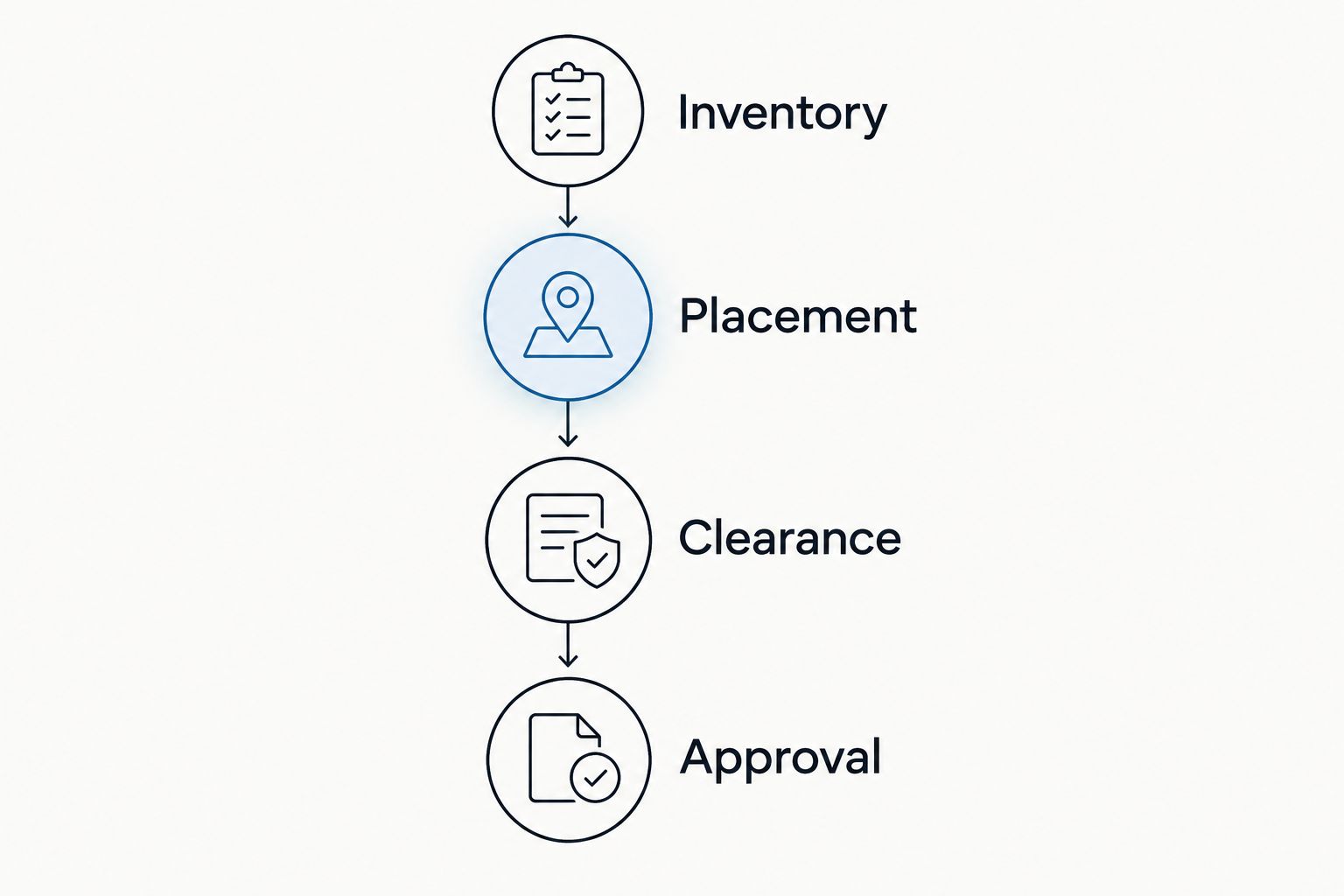
Use this sequence with your cabinetry designer:
- Inventory: Identify what stays in the kitchen and separate daily items from occasional equipment.
- Placement: Assign each category to the preparation, cooking, serving, or cleanup area.
- Clearance: Review doors, drawers, accessories, and appliances in their operating positions.
- Approval: Confirm accessory models and interior dimensions before fabrication.
Small-container storage deserves the same discipline as cookware. Drawer inserts and spice rack organizers solve different access problems: the former expose labels from above, while rack arrangements depend on their mounting position and the containers they hold. Choose the storage location before choosing the organizer format.
At drawing review, check 2 operating positions for each moving accessory: closed and fully extended. Then review combinations, such as the waste pullout open beside the dishwasher. Individual fit does not prove that adjacent elements work together.
The Los Angeles cabinet maker’s shop drawing review is where these decisions belong. For your 2026 approval set, request 1 accessory schedule identifying each mechanism, its cabinet location, and its installation requirements.
How these accessories are ranked
This ranking prioritizes daily task fit, visible access, usable storage, and straightforward planning. Deep-drawer dividers lead because they organize a central kitchen task without requiring a specialized cabinet location. Corner mechanisms and tall pantry pullouts rank lower because their value depends more heavily on the surrounding layout.
This is a specification guide, not a hardware-brand test. The final choice depends on the dimensions and requirements of the selected fitting.
Which kitchen cabinet storage accessories should you choose?
Start with deep-drawer dividers, a well-positioned waste pullout, and vertical tray storage. Together, they address cookware, cleanup, and flat equipment without making every cabinet mechanically complex.
Add spice inserts only where the collection and location justify them. Treat corner mechanisms and tall pantry pullouts as layout-specific decisions, not default upgrades.
Polaris Home Design approaches kitchen cabinetry through in-house design, build, and installation. For a complete custom project, discuss the cabinet arrangement and accessory requirements together so the interior supports the design rather than becoming an afterthought.
Plan your complete custom kitchen
Discuss cabinetry layout, storage priorities, and the in-house design, build, and installation process.
FAQ
What are the best kitchen cabinet storage accessories for everyday use?
Deep-drawer dividers, waste-and-recycling pullouts, and vertical tray dividers are the strongest starting choices for everyday use. Select each around your cookware, cleanup routine, and cabinet layout.
Are rollout shelves better than kitchen drawers?
Rollout shelves are not automatically better than kitchen drawers. Rollouts suit shelf-style storage behind doors, while drawers provide access through a drawer front without opening a separate cabinet door.
Should I add a pullout to every corner cabinet?
No. Choose a corner pullout only after comparing the usable storage and operating clearance with alternative cabinet arrangements. The mechanism itself occupies space.
When should I choose storage accessories for custom cabinets?
Choose storage accessories before approving fabrication drawings. Their mounting requirements, dimensions, and movement affect cabinet construction and neighboring clearances.
What should I bring to a kitchen storage consultation?
Bring an inventory, photographs of your current storage, and measurements of difficult-to-store items. Include cookware handles, large boards, countertop appliances, and the containers you intend to keep.
Can Polaris Home Design plan accessories within a complete kitchen project?
Polaris Home Design offers custom kitchen cabinetry with in-house design, build, and installation. Discuss your storage requirements as part of the complete cabinetry project, with specific fittings confirmed during planning.
One last thing
Before signing your 2026 cabinet drawings, choose your most awkward kitchen object and ask where it fits. A roasting pan, appliance attachment, or oversized board can expose a storage problem that a neat elevation drawing hides. Approve a place for the difficult items, not just the easy ones.