Best overall: open shelves above closed base cabinets. Best for traditional rooms: inset paneled cabinetry. Best for modern interiors: slab-front cabinetry. This 2026 guide compares the best built-in cabinet styles for home libraries for Los Angeles homeowners commissioning a complete custom cabinetry project.
- The best built-in cabinet styles for home libraries balance book access, concealed storage, and the room’s architecture.
- Open shelves above closed base cabinets are the strongest default for mixed-use home libraries.
- Choose inset paneled cabinetry for traditional detail and slab-front cabinetry for restrained modern rooms.
- Polaris Home Design suits homeowners seeking custom cabinetry designed, built, and installed in-house.
Why this matters
A library wall must accommodate more than book spines. Your cabinets also need to account for oversized volumes, objects, outlets, adjacent furniture, and the way you move through the room.
Choose the storage arrangement before choosing the door profile. A beautiful elevation still fails your brief if everyday books sit beyond comfortable reach or paperwork occupies the shelves intended for display.
Polaris Home Design is a Los Angeles bespoke cabinetry studio with an in-house design, build, and installation approach. For your 2026 remodel, bring the same whole-project discipline to a library wall that you would bring to a custom kitchen: resolve function, materials, drawings, and installation together.
What makes the best home library cabinetry
Use these criteria to judge the styles below. The strongest choice answers your storage brief without fighting the room.
- Book access: Keep frequently used books within comfortable reach and identify where oversized volumes belong.
- Concealed storage: Decide which papers, devices, and household items need doors or drawers.
- Architectural fit: Relate door profiles, trim, and proportions to the room’s existing features.
- Shelf construction: Specify shelf material, unsupported span, support method, and intended load together.
- Room clearance: Check door swings, seating, circulation, and access to outlets before approving the layout.
- Finish continuity: Coordinate visible wood grain, painted surfaces, hardware, and adjacent cabinetry without making every room identical.
A style name is not a construction specification. Open shelving, inset doors, and slab fronts describe different aspects of cabinetry; the recommendations below treat them as complete design directions rather than interchangeable door options.
Home library cabinet styles at a glance
| Rank and style | Best for | Standout feature | Key limitation |
|---|---|---|---|
| 1. Open shelves with closed bases | Libraries that also function as living rooms | Accessible books above concealed everyday storage | Open shelves still require dusting and visual editing |
| 2. Inset paneled cabinetry | Traditionally detailed interiors | Doors sit within the face frame | Alignment and clearances need careful specification |
| 3. Slab-front cabinetry | Restrained modern interiors | Flat doors keep the elevation visually quiet | Broad surfaces make finish and grain decisions prominent |
| 4. Glass-front cabinetry | Display-led collections | Books remain visible behind doors | Reflections and door swings affect everyday use |
| 5. Full-height open shelving | Book-first reading rooms | Repeated shelves prioritize accessible display | No concealment and difficult access at the top |
| 6. Desk-integrated cabinetry | Libraries that double as workspaces | Work surface and book storage share one composition | Workspace requirements reduce book-storage area |
1. Open shelves with closed bases: best for shared living spaces
Open shelves above closed base cabinets provide a clear division between display and utility. Books and selected objects remain visible, while doors or drawers conceal paperwork, chargers, and miscellaneous belongings.
This is the best default when your home library shares a living room or sitting area. Begin with what needs hiding, then design the shelving above it; otherwise, the base cabinets become leftover space rather than useful storage.
Open-shelf and closed-base pros:
- Combines visible books with concealed household storage.
- Gives the lower elevation a consistent visual base.
- Supports a mix of drawers and doors according to contents.
Open-shelf and closed-base cons:
- Exposed books and horizontal surfaces need dusting.
- Base depth and open doors must work around nearby furniture.
Best for: Homeowners creating a library within a room used by the whole household.
Verdict: Buy this direction when your brief includes both books and everyday clutter.
2. Inset paneled cabinetry: best for traditional architecture
Inset doors sit inside the cabinet face frame rather than covering it. Combined with paneled fronts and considered trim, this creates a furniture-like elevation suited to traditionally detailed rooms.
Choose the profile in relation to existing doors, casings, and ceiling details. A library does not need elaborate molding simply because the cabinetry is traditional; restrained paneling can carry the architectural connection.
Inset paneled cabinetry pros:
- Establishes a defined relationship between doors and face frames.
- Offers panel profiles that connect with existing interior details.
- Works with open shelves or closed upper cabinets.
Inset paneled cabinetry cons:
- Consistent door clearances and alignment require careful detailing.
- Elaborate profiles add surfaces and recesses to clean.
Best for: Homeowners preserving a traditionally detailed room rather than introducing a competing modern vocabulary.
Verdict: Buy for architectural continuity; skip ornate profiles that have no connection to the house.
3. Slab-front cabinetry: best for modern interiors
Slab-front cabinetry uses flat door and drawer faces without a framed panel profile. It keeps attention on proportions, material, and the relationship between open and closed sections.
For a modern library, decide whether the cabinetry should read as a quiet wall or a visible wood composition. Painted fronts emphasize a continuous surface; visible wood grain makes grain direction and transitions part of the design.
Slab-front cabinetry pros:
- Keeps the door design visually restrained.
- Allows grain direction to become a deliberate design feature.
- Coordinates with simple shelving and minimal trim.
Slab-front cabinetry cons:
- Large uninterrupted surfaces make finish inconsistencies noticeable.
- Handleless arrangements require an explicit opening method, not just omitted hardware.
Best for: Homeowners whose rooms already use clean lines and limited decorative trim.
Verdict: Buy for a restrained modern library, after approving finish samples and the opening detail.
4. Glass-front cabinetry: best for display-led collections
Glass-front doors keep books and objects visible while placing a barrier between the collection and the room. They suit homeowners who want a display cabinet rather than entirely open shelving.
Glazing does not turn ordinary cabinetry into a sealed preservation enclosure. If you own fragile or valuable books, address conservation requirements separately rather than treating glass doors as complete protection.
Glass-front cabinetry pros:
- Shows book spines and objects with the doors closed.
- Provides a physical barrier against casual handling.
- Divides a large elevation into framed display areas.
Glass-front cabinetry cons:
- Glass introduces reflections and another surface to clean.
- Doors need opening clearance in front of the shelves.
Best for: Homeowners displaying a curated collection that does not need constant open access.
Verdict: Buy for visible, enclosed display; skip if reflections or frequent door opening will frustrate you.
5. Full-height open shelving: best for book-first reading rooms
Full-height open shelving makes the collection the main feature of the room. Without upper doors, you can see and retrieve books directly from each accessible shelf.
The design challenge is not simply filling the wall. You need a practical plan for high shelves, suitable shelf construction, and a deliberate stopping point at the ceiling or surrounding trim.
Full-height open shelving pros:
- Makes the collection easy to scan.
- Keeps accessible books directly available without opening doors.
- Allows shelf spacing to respond to different book formats.
Full-height open shelving cons:
- Offers no concealed storage for unrelated belongings.
- Upper shelves need a safe access strategy.
Best for: Homeowners dedicating a room primarily to books and reading.
Verdict: Buy when books are the priority; skip if you also need substantial hidden storage.
6. Desk-integrated cabinetry: best for library workspaces
Desk-integrated cabinetry combines a work surface with surrounding shelves and cabinets. It gives a library a defined place for reading notes, correspondence, or computer work.
Start with seated use, not a symmetrical elevation. Chair movement, legroom, equipment, cable routes, and nearby doors determine whether the desk functions comfortably after installation.
Desk-integrated cabinetry pros:
- Combines book storage and a designated work area.
- Provides an opportunity to plan concealed cable routes.
- Coordinates the desk with the surrounding cabinetry.
Desk-integrated cabinetry cons:
- The work surface and leg space displace potential book storage.
- Devices and cables can remain visually prominent without a clear storage plan.
Best for: Homeowners who use their library for regular desk work rather than reading alone.
Verdict: Buy when working at a desk is part of your daily routine; skip an unused desk added only for symmetry.
How these styles were ranked
The ranking prioritizes book access, concealed storage, architectural fit, shelf construction, room clearance, and finish continuity. Open shelves above closed bases lead because they address both visible collections and hidden household storage; the remaining styles serve more specific room requirements.
This is a planning comparison, not a product test or a claim that one construction method always outlasts another. For a 2026 commission, the approved materials, details, and installation scope matter more than the style label alone.
Turn the preferred style into a buildable brief
Before discussing finishes with Polaris Home Design, define what the cabinetry must accommodate. A homeowner in North Hollywood, Burbank, or Glendale benefits from the same starting point: a room-specific brief rather than a collection of unrelated inspiration images.
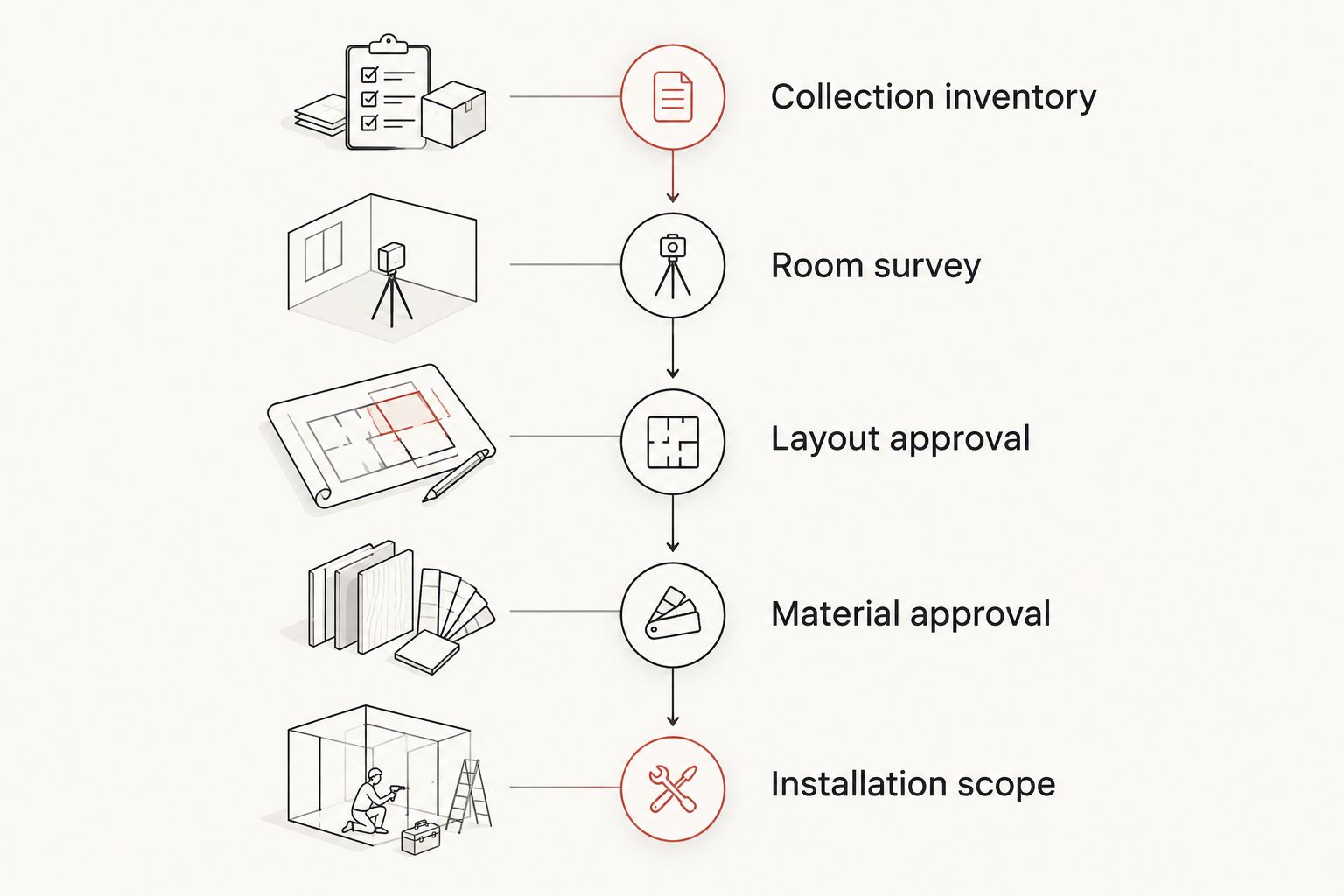
Organize that brief into these decisions:
- Collection inventory: Identify everyday books, oversized volumes, display objects, and items that require concealment.
- Room survey: Record windows, doors, outlets, vents, existing trim, and furniture that will remain.
- Layout approval: Confirm shelf divisions, base storage, door swings, and any desk position.
- Material approval: Review the actual finish sample, visible edges, grain direction, and shelf construction.
- Installation scope: Establish responsibility for wall attachment, fitting, trim interfaces, hardware adjustment, and completion checks.
Review the elevation alongside a section drawing. The elevation shows the composition; the section explains depth, shelf position, and how cabinetry meets the room. Use the guide to reviewing a cabinet maker’s shop drawings to structure that discussion.
Do not approve shelf spacing from an inspiration photograph. Bring representative books and identify the largest items before finalizing the drawing. For a project commissioned in 2026, keep the approved drawings and finish selections together so design, fabrication, and installation refer to the same decisions.
Discuss your complete cabinetry project
Bring your room plans, storage priorities, and preferred cabinet style to the project discussion.
Which home library cabinet style should you choose?
Choose open shelves above closed bases unless your room has a clear reason to do otherwise. Move to inset paneling for traditional architectural continuity, slab fronts for modern restraint, glass fronts for enclosed display, full-height open shelving for a book-first room, or an integrated desk for regular work.
Polaris Home Design is best for homeowners seeking complete custom cabinetry with in-house design, build, and installation. Bring a preferred direction to the discussion, but let your collection and room constraints determine the final composition—not the ranking alone.
FAQ
What’s the best built-in cabinet style for a home library?
Open shelves above closed base cabinets are the best default for a home library that also serves as a living space. The shelves keep books accessible while the bases conceal paperwork and household items.
Are inset cabinets better than slab-front cabinets for a library?
Inset cabinets are better for traditionally detailed rooms; slab fronts suit restrained modern interiors. Choose according to the room’s architecture rather than treating either door style as a universal quality standard.
Should home library cabinets have glass doors?
Choose glass doors when visible, enclosed display matters more than immediate open access. Account for reflections, cleaning, and door swings, and do not treat ordinary glass-front cabinets as conservation enclosures.
How deep should custom library shelves be?
Set shelf depth from the books and objects you intend to store. Bring representative items and review the section drawing so oversized volumes, door clearance, and room circulation are resolved together.
Can a home library include a built-in desk?
Yes, a desk can share a composition with library shelves and cabinets. Plan seated use, chair movement, legroom, equipment, and cable routes before approving the elevation.
What should I approve before my library cabinetry is built?
Approve the layout, dimensions, shelf construction, door operation, finish samples, hardware, and installation scope. Keep these decisions in the project drawings and written specifications rather than relying on inspiration photographs.
What should I bring to a custom cabinetry consultation in 2026?
Bring room plans or available measurements, photographs, representative books, a storage inventory, and images showing your preferred style. Identify furniture that will remain and explain whether the room is primarily for reading, display, or work.
One last thing
The largest book in your collection can expose a weak layout faster than a wall of inspiration images. Bring it to the design discussion, along with an ordinary volume and any object you intend to display. Approve the cabinetry around what it must hold, then refine how it looks.