Best overall specification starting point: two-component polyurethane. Best for flat-panel abrasion resistance: high-pressure laminate. Best for visible wood grain: conversion varnish. This 2026 guide to cabinet finishes ranked by durability for designers compares complete finish systems—not appearance alone—for Los Angeles custom cabinetry projects.
- Two-component polyurethane is the first specification candidate for demanding cabinetry; verify the exact system’s performance documentation.
- High-pressure laminate suits flat-panel cabinetry where surface wear matters, but edges and seams remain critical.
- Conversion varnish suits visible wood grain; hardwax oil favors localized maintenance over maximum barrier protection.
- Polaris Home Design serves designers commissioning complete custom cabinetry, from design through installation.
Why this matters
A finish name does not tell you how a cabinet door will perform. Substrate preparation, application, curing, edge treatment, and cleaning requirements all affect the finished assembly. A durable face cannot compensate for an exposed edge beside a dishwasher.
For interior designers specifying North Hollywood kitchens or cabinetry elsewhere in Los Angeles, the decision belongs in the complete project brief. Polaris Home Design offers bespoke kitchen cabinets, bathroom vanities, and closets, with design, build, and installation handled in-house.
Polaris Home Design is best suited to designers seeking a complete custom cabinetry project rather than a finish-only purchase. Discuss the surface together with door construction, appliance relationships, installation details, and maintenance expectations.
What makes the best cabinet finish for designers?
Use these criteria before approving a finish for a 2026 cabinetry specification:
- Chemical resistance: Request documentation for the exact coating or surface, including relevant household substances and cleaning restrictions.
- Abrasion resistance: Distinguish repeated rubbing from a single scratch or impact. These are different damage mechanisms.
- Moisture detailing: Review edges, cutouts, joints, and sink-adjacent construction—not just the broad face.
- Repairability: Establish whether damage requires localized work, shop refinishing, or replacement of a component.
- Appearance control: Approve color, sheen, texture, and grain visibility on the intended substrate.
- Process control: Confirm preparation, application, curing requirements, and responsibility for the finished result.
Specify the complete system, not an adjective such as durable, washable, or premium. A supplier’s technical documentation and an approved physical sample provide a clearer basis for selection than a generic finish label.
Cabinet finishes at a glance
The order below ranks specification priorities, not laboratory results across every formulation. High-pressure laminate is a bonded decorative surface, while the other entries are applied coatings or oil-based treatments; including it makes the comparison useful for complete cabinetry decisions.
| Rank and finish | Best for | Standout characteristic | Key limitation |
|---|---|---|---|
| 1. Two-component polyurethane | Demanding custom-painted cabinetry | Chemically cured coating system | Localized repairs can be difficult to blend |
| 2. High-pressure laminate | Flat-panel cabinetry exposed to repeated surface wear | Factory-manufactured decorative wear surface | Edges and seams require separate attention |
| 3. Conversion varnish | Wood-grain cabinetry needing a protective film | Catalyzed clear-coating option | Damage can require substantial refinishing |
| 4. Pre-catalyzed lacquer | Detailed cabinetry with moderate exposure | Spray-applied film suited to shaped profiles | Product-specific resistance needs close review |
| 5. Hardwax oil | Tactile wood cabinetry with planned maintenance | Low-build appearance and localized maintenance potential | Less suitable where maximum barrier protection is the priority |
1. Two-component polyurethane: best for custom-painted kitchens
Two-component polyurethane combines a coating with its specified hardener to form a chemically cured film. It is a strong starting point for designers seeking a protective painted finish, but the chemistry label alone does not establish scratch, stain, or cleaner resistance.
In a 2026 kitchen specification, identify the actual product system, substrate, primer, and intended sheen. Ask how the finisher controls mixing, application, and curing before doors are handled or installed.
Two-component polyurethane pros:
- Provides a film-forming option for custom-painted cabinetry.
- Allows color and sheen to be specified as part of the coating system.
- Supports shaped doors as well as flat surfaces when the application system permits.
Two-component polyurethane cons:
- Touch-ups can leave differences in sheen or texture.
- Successful application depends on controlled preparation and processing.
- A resistant coating does not prevent dents in the substrate beneath it.
Best for: Designers prioritizing a custom-painted kitchen and documented finish performance.
Verdict: Buy the documented system, not polyurethane by name alone.
2. High-pressure laminate: best for flat-panel surface wear
High-pressure laminate bonds a manufactured decorative sheet to a suitable substrate. It belongs in a durability comparison because it changes the specification from an applied coating to a surfaced panel assembly.
Its practical advantage is the wear surface; its detailing challenge is the perimeter. Review the edge treatment, adhesive system, penetrations, and transitions before approving a kitchen or closet package.
High-pressure laminate pros:
- Provides a manufactured surface with product-specific performance documentation.
- Suits flat-panel doors and repeated modular elements.
- Offers decorative finishes without relying on an exposed wood surface.
High-pressure laminate cons:
- Visible seams can conflict with a continuous painted appearance.
- Damaged faces are not refinished like conventional wood coatings.
- Water entering a vulnerable joint can affect the underlying assembly.
Best for: Designers specifying flat-panel cabinetry where repeated surface wear outweighs a seamless painted look.
Verdict: Buy for the right panel design; hold approval until edges are resolved.
3. Conversion varnish: best for protected wood-grain cabinetry
Conversion varnish is a catalyzed film finish used on wood cabinetry. It is a useful candidate when the design calls for visible grain with a protective clear coating rather than a low-build oil appearance.
Do not confuse the clear finish with the stain beneath it. Review the wood species, stain, sealer, and topcoat together because that combination determines the approved appearance.
Conversion varnish pros:
- Preserves the visual role of the wood grain.
- Provides a protective film over the prepared wood surface.
- Can form part of a coordinated stained-cabinetry specification.
Conversion varnish cons:
- Local damage can require refinishing beyond the immediate mark.
- Application and curing must follow the specified system.
- A clear coating does not make natural wood color uniform.
Best for: Designers specifying stained or clear-finished cabinetry with visible wood grain.
Verdict: Buy when the complete wood-and-coating sample meets the brief.
4. Pre-catalyzed lacquer: best for detailed, moderate-exposure cabinetry
Pre-catalyzed lacquer contains its catalyst within the supplied finishing system. It is a spray-applied option for detailed cabinetry, but do not treat every lacquer as equivalent or assume that catalyzed means identical performance to conversion varnish.
For library cabinetry, dressing areas, or other moderate-exposure locations, assess its documented resistance against the actual use. Carry that review through to decorative profiles and frequently handled edges.
Pre-catalyzed lacquer pros:
- Suits spray finishing of shaped cabinetry components.
- Provides a film finish without concealing the specified door profile.
- Can support coordinated color or clear-finish schemes, depending on the product.
Pre-catalyzed lacquer cons:
- Cleaner and chemical resistance vary by formulation.
- Repair procedures remain product-specific.
- The generic lacquer label is insufficient for a demanding kitchen specification.
Best for: Designers coordinating detailed cabinetry in locations with moderate exposure.
Verdict: Hold until the exact formulation meets the room’s requirements.
5. Hardwax oil: best for tactile wood with planned maintenance
Hardwax oil treatments emphasize the appearance and feel of wood without a heavy film-build aesthetic. They suit a brief that accepts maintenance as part of ownership rather than treating it as an unexpected defect.
Localized maintenance can be possible with compatible systems, but the procedure depends on the product and damage. Confirm the cleaning and renewal instructions before presenting this finish to your client.
Hardwax oil pros:
- Keeps the wood’s tactile character central to the design.
- Supports a low-build visual treatment.
- Offers localized maintenance potential with suitable systems.
Hardwax oil cons:
- Requires explicit care and maintenance expectations.
- Is not the default choice for maximum moisture and chemical barrier protection.
- Local maintenance does not guarantee an invisible color match.
Best for: Designers specifying wood cabinetry for clients who accept a maintenance-led finish strategy.
Verdict: Skip for maximum-barrier briefs; buy for an informed tactile-wood brief.
How this ranking works
The 2026 ranking prioritizes protective performance, then examines construction limitations and repair consequences. It separates custom-painted cabinetry, flat-panel wear surfaces, clear-coated wood, detailed moderate-exposure cabinetry, and maintenance-led wood finishes into distinct decisions.
There is no universal winner across every chemical, impact, scratch, substrate, and application method. Product-specific test documentation outranks this category-level order. A well-documented system that meets your project requirements is preferable to a higher-ranked category without an accountable specification.
Turn the finish choice into an approval sequence
For a complete cabinetry commission, Polaris Home Design’s in-house design, build, and installation approach keeps the finish discussion within the wider project. Your approval sequence should connect the selected appearance to the construction and care requirements.
Substrate review
Specify what sits beneath the finish and how exposed edges are treated. Painted faces, veneered panels, and surfaced boards create different detailing questions; review those differences alongside plywood or MDF kitchen cabinets.
Sample approval
Request 1 representative door sample rather than approving a color chip alone. Include the intended profile, edge, substrate, and sheen so the approval relates to something the shop can reproduce.
Exposure review
Inspect the sample under 2 lighting conditions: daylight and the planned electric lighting. Then identify sink areas, appliance-adjacent panels, and frequently handled doors on the drawings; appearance approval and exposure review are separate tasks.
Care handover
Request 3 documents: the approved finish schedule, the applicable technical data, and written care instructions. Record the sample reference and who authorizes substitutions before production begins.
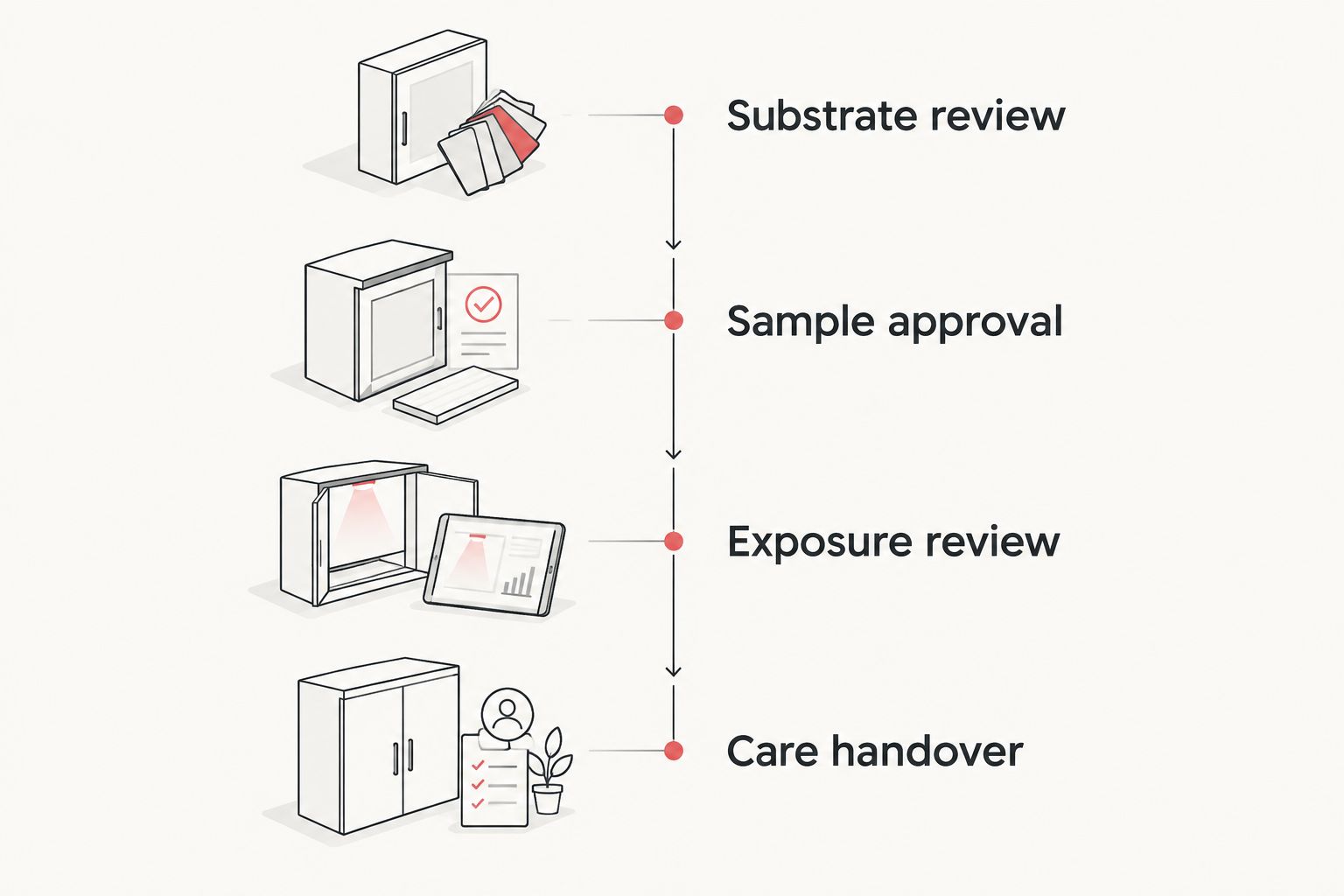
A 2026 finish schedule should also identify responsibilities when site conditions affect installation. Keep those decisions attached to the cabinetry package rather than scattered across emails about color, hardware, and appliances.
Discuss your complete cabinetry specification
Bring your design brief, finish priorities, and cabinetry scope to Polaris Home Design.
Which cabinet finish should you choose?
Start with two-component polyurethane for a custom-painted kitchen, then require evidence for the exact coating system. Choose high-pressure laminate when the design favors flat panels and a manufactured wear surface. Choose conversion varnish when protected, visible wood grain drives the brief.
Keep pre-catalyzed lacquer tied to a documented exposure requirement. Select hardwax oil only when the client understands its care strategy. Do not turn an attractive sample into an unsupported promise of maintenance-free ownership.
For a North Hollywood or broader Los Angeles commission, Polaris Home Design’s custom cabinetry scope makes the consultation a place to resolve finish, construction, and installation together—not simply choose a swatch.
FAQ
What is the most durable cabinet finish for a custom kitchen?
Two-component polyurethane is a strong starting point for a custom-painted kitchen, but the exact system must meet the project’s requirements. Compare documented chemical and wear resistance, substrate preparation, and edge detailing before approval.
Is conversion varnish better than polyurethane for cabinets?
Conversion varnish is not universally better than polyurethane. Compare the specific systems against the required appearance, exposure, application process, and repair procedure rather than choosing by category name.
Is laminate more durable than painted cabinetry?
Laminate and painted cabinetry have different failure points. Laminate provides a manufactured wear surface, while painted cabinetry relies on an applied coating; compare edges, seams, substrate, and repair consequences as well as the face.
Does a matte cabinet finish resist scratches better than gloss?
Sheen alone does not establish scratch resistance. Matte and gloss also reveal marks differently, so assess the exact product’s performance and inspect a representative sample.
Can designers specify hardwax oil for kitchen cabinets?
Designers can specify hardwax oil when the exposure conditions and maintenance expectations fit the product. It is not the default choice when maximum moisture and chemical barrier protection drives the brief.
What should a designer approve before cabinet finishing begins?
Approve the substrate, representative door sample, finish schedule, and relevant technical requirements before finishing begins. Record the selected sheen, color, edge treatment, and sample reference in the project documentation.
What should a 2026 cabinet finish specification include?
A 2026 cabinet finish specification should identify the exact system, substrate preparation, approved appearance, exposure requirements, and care instructions. Define who approves substitutions and how the finished work is checked against the sample.
One last thing
Inspect the back and edges of the sample door, not just the face. A beautiful front tells you little about an unfinished cutout, a vulnerable joint, or an unclear edge specification. Ask the cabinetmaker to explain those details before you authorize the complete project.